Tuesday, June 11, 2013

Plight of nesting swans and coots at Greenland Dock


My thanks to Steve Cornish, the Chair of the Friends of Russia Dock Woodland for bringing to general attention the plight of the nesting swans at Greenland Dock.

In a letter to Southwark Council copied to a number of interested local parties, Steve made a powerful complaint about the Council's failure to maintain nesting pontoons and provide nesting material, which has caused various problems including pontoons coming loose, coots nesting with crisp packets and carrier bags and the resident swans at Greenland Dock nesting on a sinking pontoon.

A few days ago the female swan and her five eggs were only just above water level, and every time the cob (male swan) joined the pen (female swan) on the pontoon it sunk even lower .  Members of the public, who spotted the situation, have managed to rig together pieces of rope with home-made grappling hooks to fasten the slowly sinking pontoons to the side of the dock in an attempt to prevent her eggs from perishing. You can see the ropes attaching the pontoon to secure dockside fixtures on the photograph above. The same local residents have also provided much more nesting material so that the nest has now been raised above the water level. Whether this has been enough to save the eggs will become clear in the next week or so.  

In the Greenland Dock side of Norway Cut (the bit still connected to Greenland Dock), a pair of coots are attempting to nest on a submerged pontoon.  Their only nesting material so far consists of a feeble number of fallen leaves, a bit of blue rope and some rubbish.  The whole thing is below the water surface and does not hold much hope for a successful hatching. 

This is so disappointing. Southwark Council desperately needs to ensure that the budget and the personnel are available to resolve this situation, if not now when it is nearly too late, then on an ongoing basis in the future.  This should be routine, scheduled work.  Consistent with their rejected proposal to turn the highly regarded open space of Greenland Dock into a marina last year, it is sad that Southwark Council continues to demonstrate disregard for the needs of the dock's resident wildlife.


The East London Thames, and the Albert and Victoria Docks from the air

Just because it's pretty.  Around 12 years ago I was flying back into London and was lucky enough to get this photograph at sunset from the plane.   I found it quite by chance earlier this afternoon whilst going through some print photos (I went digital around 10 years ago), looking for a photograph of something else entirely.  You can easily pick out the Royal Albert and Royal Victoria Docks, and the Thames Barrier at Woolwich. 

I also have some photos, taken from Rotherhithe, of Canary Wharf half-built, a vision of multi-coloured cranes, and Metropolitan Wharf in a still derelict state.  Fascinating to compare the past of only 10 or so years ago with the present.


Saturday, June 8, 2013

Open Gardens Day: Stave Hill Ecological Park

http://www.se16.com/event/open-gardens-day


Come to the SHED garden for a weekend of wildlife activities
  • Follow quiz trails and hunt for mini beasts
  • Create sun catchers, mini mosaics and windmills
  • Have your hand painted and design a wildlife poster
  • Meet the bee keeper, and learn all about the Stave Hill bees
Follow the SHED signs from Dock Hill Avenue or Waterman’s Walk, Russia Dock Woodland


Friday, June 7, 2013

Broken up in Rotherhithe: HMS Queen 1839-1871

I have an eternal fascination with ships, and have written about several on this blog.  After Rotherhithe's hey-day of building wooden sailing ships, the industry started to change and instead of building ships, some of the great shipwrighting names in the area turned to breaking rather than building.

The HMS Illustrious from the Thames Vessels blog at
http://bit.ly/ZyGHi5
Recently, the aircraft carrier HMS Illustrious visited Greenwich and although I didn't get the chance to go on board, it was fabulous to see her massive hull soaring out of the water from the level of the Thames Clipper.  HMS Illustrious is about to share the same fate of 100s of British warships that have ceased to be considered to be suitable for service.  She is about to be broken up for scrap. A sad thing.

The most famous ship to be broken up locally was the HMS Temeraire, immortalized in J.M.W. Turner's glorious painting The Fighting Temeraire, in which he depicted the magnificent ship being towed down the Thames to be broken up.  I've posted about that in an earlier post, which is accompanied by a rather tragic photograph of her pitiful condition in her last days.  In the mid to late 19th Century the breaking of ships was a lucrative business.  The Admiralty sold unwanted warships to private companies who broke up the ships and sold off the parts.  Metal fittings and wood were the most valuable parts, but even the rope was sold off.

A similar illustration was published in 1871 of the breaking that year of the marvellous HMS Queen.

HMS Queen by Robert Strickland Thomas
HMS Queen, named for the newly crowned Queen Victoria, was built in Portsmouth and was launched on 15th May 1839. Victoria visited her in 1842.  She was a triple decked 110 gun First Rate ship of the line, similar to the Temerarire.  She is something of a landmark in the history of battleships, as she was the last to be built with sail power alone.  Steam saw the end of the sail-powered battleship, and after serving in the Crimean War, the HMS Queen was herself converted to screw-steam power in 1859, and was reduced to two decks and 86 guns. There's a photograph of her at the Royal Navy Museum in Portsmouth showing her with all three masts, yards, her bowsprit and only two decks, with a steam funnel sitting just behind the foremast - it is a most peculiar vision. 

HMS Queen was brought to Rotherhithe to be broken up in in Surrey Canal Wharf, formerly one of the Beatson yards, by William Beech and Henry Castle.  She was the last large warship to be broken up in Rotherhithe.  She should have been worth a considerable amount of money once broken up, but on her arrival at the yard she was stranded on the foreshore by the ebbing tide and her back snapped, splitting her in two, meaning that the long lengths so desirable to purchasers were halved and much of her value was lost.

She was the last wooden warship broken this far up the Thames. The Illustrated London News covered the story on September 9th 1871, with the illustration shown on this page.


Thursday, June 6, 2013

Southwark to investigate cycle hire expansion to SE16


See the SE16.com website for more re the possibility of extending Boris Bikes into Rotherhithe. Southwark Council are to launch a £15.000 investigation into the matter:

http://www.se16.com/1179-southwark-to-investigate-cycle-hire-expansion-to-se16


Wednesday, June 5, 2013

Coot chicks in the sealed part of Norway Cut


I am anything but sentimental about coots.  They are both noisy and aggressive, and they regularly wake me up at a ridiculously early hour with their bickering, but their tiny and ugly chicks, with their bright foliage and funny little peeping voices are somehow endearing. They resemble miniature turkeys rather than the water birds that they grow up to be.  Norway Cut has been divided into two sections. One part is still connected to Greenland Dock, but in the old connecting passage between the two docks there is now a piece of water that is isolated from both Greenland Dock and Norway Dock.  This part of Norway Cut, which is completely sealed at both ends, will be the home for the parents and their chicks until the chicks are large enough to fly out.  Since last year someone has put a floating blue duckhouse in the water, which is also rather endearing.  Here are some pics.

There were swans with cygnets on Norway Dock itself, but the new camera wasn't up to dealing with the contrast of dark water and bright white swans without manual intervention (and I haven't figured that part out just yet).


Thames Tideway Tunnel update

The proposed Chambers Wharf
site on the Thames Tideway site at
http://bit.ly/12s25t9
Anyone who was following discussions (and disputes) about where the Thames Tideway supersewer should be located will be aware that the King's Stairs Gardens was one options being considered.  There was an active local campaign to reject its location in Rotherhithe, the Save King's Stairs Gardens campaign.  Eventually it was announced that the King's Stairs Gardens was no longer the Thames Water favoured site.

Now the SE16.com website has reported that Council and Lib Dems set out Chambers Wharf supersewer objections.  "Southwark Council has voiced its strong opposition to proposals to use Chambers Wharf for the Thames Tideway Tunnel supersewer.  The council has set out its objections in its first formal response to the Planning Inspectorate on the impacts of the proposal."  See more on the SE16.com website:
http://www.se16.com/1167-supersewer-objections

For a map showing the site, see the following on Google Maps - the site is the empty patch at Chambers Street, between Bermondsey Wall East and Bermondsey Wall West:
http://bit.ly/11qZTij

More details of the planned development are on the Thames Tideway site:
http://www.thamestidewaytunnel.co.uk/site-profiles/chambers-wharf/ 

Rotherhithe news from SE16.com

From the SE16.com Twitter feed
@se16:


King's College submits plans for Mulberry Business Park site in Rotherhithe. King’s says that it plans to work with the council “to develop a town centre heart with a university environment” in the wider area, including the Harmsworth Quays site soon to be vacated by the Daily Mail.
See the following page for more:
http://www.se16.com/1161-kings-college-submits-plans-for-mulberry-business-park


Open air swimming pool returning to Decathlon on June 10th. An open-air swimming pool will be installed in the Decathlon car park this summer for the second year running.On weekdays a programme of low-cost swimming lessons will be offered as part of the Mayor of London’s Make a Splash programme.
See the following page for more:
http://www.se16.com/1165-open-air-swimming-pool-returning-to-decathlon-this-summer


Tuesday, June 4, 2013

Bridges of Greenland Dock


There are four bridges of historical interest around the edges of Greenland Dock, only one of which is in its original position.  When the London Dockland Development Council decided to retain Greenland Dock, rather than filling it in, as had been done for most of the other docks, it was an obvious place to gather some of the original bridges.  The lattice bridge across the lock into Greenland Dock is in its original place; the others were brought in from other nearby areas to preserve them in an authentic environment.  They are all remarkably different from each other, and each is delightful.  A circuit of the dock makes a good short walk, and the bridges provide some really good landmarks and the views from  the lattice bridge are particularly good.


Lattice footbridge, Rope Street

Lattice footbridge


The lattice bridge (Stuart Rankin's name for it, which suits it well, given its similarity to lattice-truss construction bridges) was manufactured by Armstrong, Whitworth and Co. from bolted cast iron and has a walking surface of wooden planks.

It was constructed here in 1904 when the lock was extended to handle larger ships. It still crosses the lock of Greenland Dock, where it was originally located. Although the lock gates, the granite steps and the hydraulic gear have been preserved, the lock is now blocked off and vessels now enter and depart Greenland Dock via Steel Yard Cut, the linking channel between Greenland Dock and South Dock.  The bridge was renovated in 1987 and still looks good. It is Grade II listed.

A magnificent structure, the bridge is one of the best features of Greenland Dock.  It was not fixed in its position. Its two parts could be swung to each side when tall ships needed to pass through the lock.  It was operated by vast hydraulic jiggers, which are still preserved today, although it no longer functions.  The swing bridge was opened and closed by high pressure water through pistons in the cylinder equipment.  They are still in position in the pits next to the bridge on each side.


Steel Yard Cut Swing Bridge

Steel Yard Cut Swing Bridge
Moving clockwise around the dock, the next bridge of interest is another footbridge, Henry Grissell's 1862 swing bridge.  It now stands permanently open on either side of the above-mentioned Steel Yard Cut. 

Known as "Iron Henry" Grissell (1817-1883) started his working life as an apprentice to the Bramah iron casting and metal working company, before establishing his own business in the early 1840s.  The company, which Henry Grissell established with his brother Martin at the Regent's Canal Ironworks, built bridges for clients all over the world, and made the the gates and railings at Buckingham Palace and the British Museum.

Here's what Southwark's Planning Department has to say about the bridge:

Swing footbridge. 1862. Designed and manufactured by Henry Grissell (a renowned ironmaster). Relocated here in mid C20 from the Surrey entrance basin. A distinctive stayed cantilever design (unusual in metal bridges) with arched span in wrought-iron, stayed by iron rods to cast-iron counterweight. Hand operating gear remains, although an oil hydraulic mechanism added in 1980s.


Scherzer rolling bascule lift bridges

The Greenland Dock Scherzer rolling bascule lift bridge
Whatever sort of bridge was used to cross the Grand Surrey Canal is long gone, and the next bridge required to cross one of the connections between docks was that between Greenland Dock and Canada Dock (now Canada Water).  Today the old passageway between the two docks is a pedestrian underpass leading to Tesco with Salter Road passing over the top of it.  Parallel to the road, also bridging the underpass, is one of Rotherhithe's two remaining bascule bridges.

The bascule bridge at the end of Greenland Dock was originally at Deptford Creek (this photograph on the City of London Collage website appears to show it in action at its old location) and was moved here in 1959 to replace the wooden bridge that was here previously.  Its twin is still in situ in its original location at the Thames entrance to Surrey Water (next to the Old Salt Quay public house).

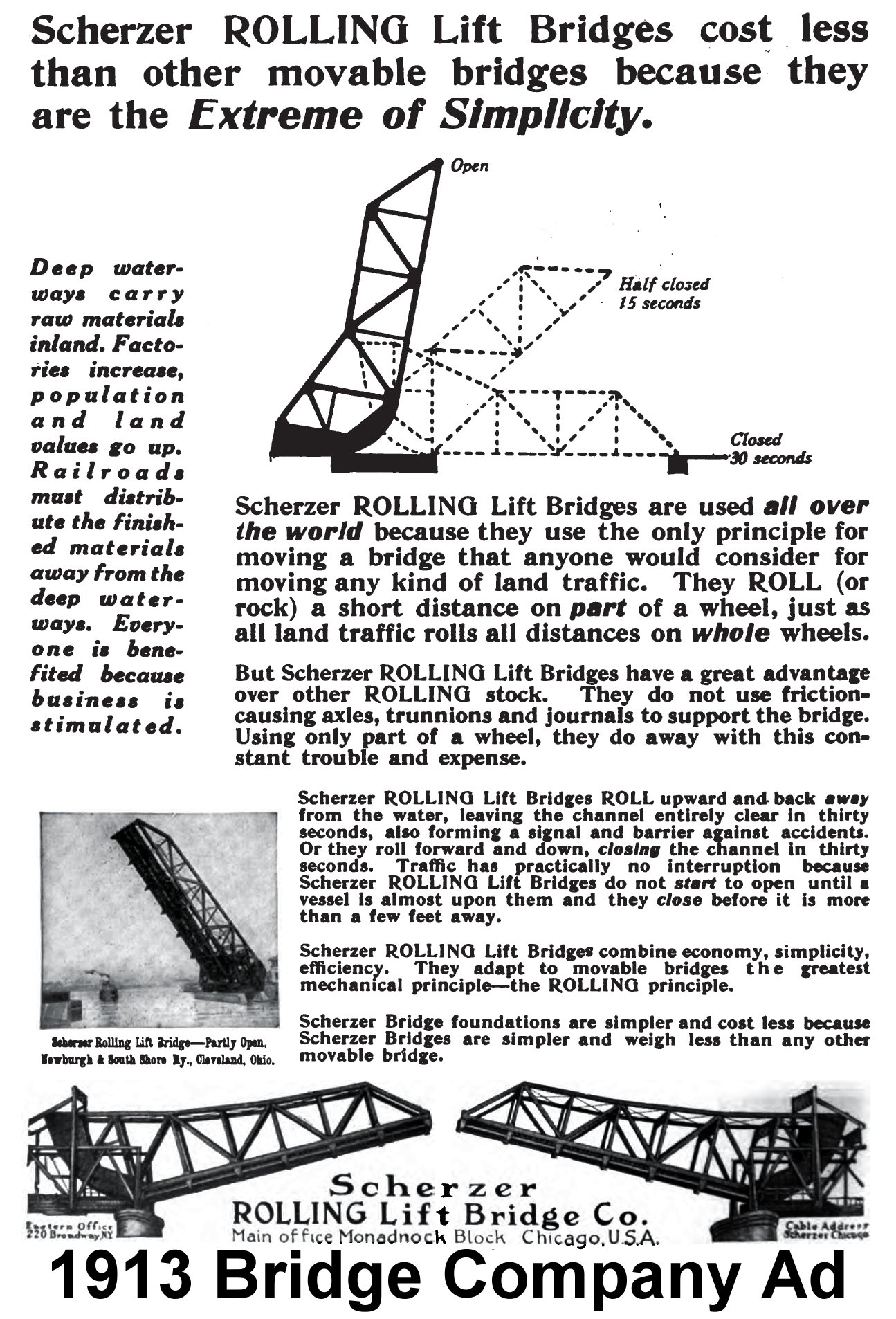
You have to love something that's called a "Scherzer rolling bascule lift bridge" even if you don't know what on Earth it means.  And it is a magnificent beast.   "Scherzer" refers to William Scherzer who pioneered a particular design of bascule bridges in the US.  The term "bascule" refers to bridges that open and close with a system of counterweights that balance the bridge continuously as the bridge rises and falls.  The whole bridge used to swing upwards on its rocker.  There's a lovely advert from 1913 on the Historic Bridges site showing how it operated: http://www.historicbridges.org/illinois/mcdonough/ad_large.jpg. Tower Bridge is a bascule bridge, but not of the Scherzer variety.


Norway Cut Swing Bridge 


Norway Cut Swing Bridge

Heading back around the dock towards the Thames once more, and passing the old inlet to Russia Dock and the Grand Surrey Canal, the final bridge on the circuit is the Norway Cut Swing Bridge.

It was designed by dock engineer James Walker in 1855 and was built by Walker, Burges & Cooper.  Its first home was at the lock entrance to South Dock. It was moved to the Norway Cut in 1987 and it, like the the other bridges around Greenland Dock, no longer moves.  It is set into two of its original granite plinths either side of the blocked off access channel (or "cut" or "cutting") to the former Norway Dock (now a development known as The Lakes).  Of you click to see the larger image, you can clearly see the gap int he middle of the bridge where the two halves meet.  It was manually powered, unlike many of the later bridges of the period, which were powered by hydraulics.  There is a round plaque providing a few details about the bridge.

James Walker by
Michael Rizzello
The bridge is now Grade II listed (English Heritage ID 471365).  Details of the listing are available at:  http://www.britishlistedbuildings.co.uk/en-471365-swing-bridge-over-cutting-between-greenl, which describes it as follows:

Wrought-iron plates and angles. Based on cast-iron precedents but owes its elegant lightness to use of wrought-iron with countersunk rivet heads, an early surviving example of riveted ironwork in bridges. Some welded steelwork discretely added in refurbishment. Original granite kerbs and paving reinstated at the new site.  

The English Heritage description also says that it is the second oldest bridge in Docklands, but somewhat frustratingly doesn't say which the oldest is!

A sculpture of James Walker is located near to the Moby Dick.


Rotherhithe in 1906.  Greenland Dock is the long dock
at the right of the image (with the shorter
South Dock at the far right).


As usual, my thanks to Stuart Rankin's excellent work for much of the information in this post (see the bibliography page).  The photographs are mine.


Views from Greenland Dock

Further to yesterday's wander round Greenland Dock with my new camera, here are a couple of snaps of the wider views.


Greenland Dock's Tavistock Tower
with The Shard in the distance


From the old lock entrance into Greenland Dock
looking over the Thames to Canary Wharf

Canary Wharf, from the marina at the Thames
end of Greenland Dock

Strata Tower at Elephant and Castle

Canary Wharf on the Isle of Dogs. Thank goodness for
the pointy top of 1 Canada Square, because without it
that particular skyline would be  a mass of squared-off
and very dull tower blocks.

Baltic Quay at South Dock (a truly innovative development,
which always stands out as something worth having in the area)
and, beyond it, the renovated but still-ugly Aragon Tower
on the edge of the Pepys Estate.

The new and deeply unappealing Barratt Homes
highrise, Ontario Point, at Canada Water

Monday, June 3, 2013

Views of Greenland Dock


I bought a new camera, which is powered by ordinary AA batteries, to supplement my giant Canon EOS digital SLR a few days ago, as something I can just chuck into my handbag when I don't want to take out the Canon. I took it out for a test run today for the first time.  It's a Fuji S4500, and even though I had seen one in a store a few weeks ago I was still taken aback by how lightweight and small it was when I opened the box.

 Having done a round of Greenland Dock with it, I find that I am absolutely not used to using anything either this tiny or weightless, and it is still odd to look through the rear screen rather than a viewfinder (although one of the reasons for buying this model is that it does offer a viewfinder as well).  It is going to take some time to become accustomed to not having all those heavy Canon optics in my hand.  But even on a first day of usage, using only the default automated settings without any attempt to manage the exposure, it hasn't done a bad job.

Here's the first set of views of Greenland Dock.  I'll post the second set, views from Greenland Dock, tomorrrow.


Coot, nest-making

Lock office on the right, with the Isle of Dogs
in the background

Henry Grissell's 1862 footbridge
in it's open position


Tavistock Tower flanked by The Shard and
the architecturally tedious Ontario Point

Cormorants on the Sailing School pontoon

Sadly neglected survivor from the
Surrey Commercial Docks

Greenland Dock

The Moby Dick

Greenland Dock towards the Isle of Dogs

Scherzer rolling bascule lift bridge

Trees lining the east side of Greenland Dock


Website: SE16.com

I stumbled across the SE16.com website a couple of days ago.  Definitely one to add to the list of useful local online resources.  The latest news is posted on the home page as an automated feed, but there are also News and Events sections, which provide archives of the most recent news stories under different categories.

Published by Bankside Press, a newsletter is sent out by email every Wednesday. They are also on Twitter at https://twitter.com/se16 and Facebook.

Bankside Press is a small family-run web and print publishing business based in London SE1.  Their main site is the eternally useful and very successful London SE1 Community Website http://www.london-se1.co.uk website has a very active discussion forum.


Friday, May 31, 2013

The Ebenezer Chapel and the Dockland Settlement Development


I have been trying to find out more about the development that is currently consuming the land that was formerly occupied by the Dockland Settlement, a considerably untidy community project that was a bit of an eyesore, but incorporated what was clearly once a rather nice chapel, the Ebenezer Chapel (a Norwegian place of worship and seamen mission), together with a contemporary two storey house, which was also obviously once very attractive.

It is all happening on the part of Rotherhithe Street that forks right off Salter Road, and is currently still marked on Google Maps as "Docklands Settlement Youth and Community Centre."  Southwark Council has this to say on the subject of the new development:

Planning application reference number 11-AP-2242
Proposal: Demolition of existing buildings, and erection of 28 residential dwellings (6x1 bed; 13x2 bed; 9x3 bed) within a part three, part four storey building at the southern end of the site with associated car parking, cycle storage and amenity spaces.  Erection of a new single storey community building (maximum height approximately 7 metres above ground) on the northern part of the site, accessed from Salter Road, providing general hall, meeting spaces and sports facilities, and a new flood-lit external sports pitch.

The Ebenezer Chapel and the attached house were recorded by archaeologists of the AOC Archaeology Group before it was demolished, and that 33 page report can be found here on the Archaeology Data Service website.:  "This was built in 1871 for the local Norwegian population. This building was recorded to Level 2 standard as defined by English Heritage Guidelines."  The photograph on this post is a screen-grab from that report, showing the Ebenezer Chapel, that stood at the site until recently.  There's a brief but good explanation of the background to the word Ebenezer (not a name, as I ignorantly thought, but from the Hebrew, meaning "stone of help") on the Missouri Conference website: http://www.moumethodist.org/news/detail/831 

If you're interested in the Scandinavian churches in Rotherhithe, there's an article on the subject from The Bridge available online at: http://www.southwark.anglican.org/thebridge/0912/0912p8.pdf.


Berkeley Homes planning new development near South Dock

There's a very short report on the Homes and Property website that gives details of one of the upcoming housing developments in Rotherhithe:  It's an extension of the existing Marine Wharf, to the east of South Dock, with 529 new flats built by Berkeley Homes.  I had a look around and more details are available on the Berkeley Homes website.  Both pages have artists' impressions.

Thursday, May 30, 2013

Views from Stave Hill


The views from the top of Rotherhithe's Stave Hill are always good. In the winter it is a lot easier to see the London Eye and Tower Bridge (you can just make them out at the far left and far right of the last of these photographs), but even with all the Spring foliage there are always buildings that stand out beyond the woodland - the new Strata Tower at Elephant and Castle (not shown in this set), 30 St Mary Axe (much better known as The Gherkin) and One Canada Square (Canary Wharf).  And now, The Shard is there on the panorama too.  The monstrosity to the immediate left of The Shard in the final photograph is, of course, Guy's Hospital, named for its founder Sir Thomas Guy (it was founded in 1721, so it can be considered some sort of success story, but one does wonder what Sir Thomas would make of it today!).

The building under construction near to the Gherkin in the first photograph is the new building at 122 Leadenhall by Richard Rogers, known locally as the Cheesegrater.  Although it wounds my soul to promote the Daily Mail, there's a rather good photo-story of the sky-scrapers popping up in the Gherkin/Cheesegrater area on the Mail Online website.


The Cheesegrater under construction and The Gherkin

The Shard

One Canada Square and the Isle of Dogs


One Canada Square

The Michael Rizzello sculpture at the
top of Stave Hill

The London Eye, far left, Guy's Hospital, The Shard and,
at far right, Tower Bridge