Showing posts with label Brunel. Show all posts

Sunday, January 24, 2016

Walking Brunel’s Thames Tunnel from Rotherhithe to Wapping (26th May 2014)


A great post on the "A London Inheritance" website about a walk through the Thames Tunnel from Rotherhithe to Wapping can be found at http://bit.ly/1QmWJ7t

Marc Brunel's Thames Tunnel, built after 18 years of problems, was finally opened for pedestrian traffic in 1843, and was eventually converted for rail in the 1865.  To see a detailed history of the Thames Tunnel, with images from the period of its build, see my earlier post

The tunnel is in constant use for the London Overground but was opened for a single weekend back in 2014, and I've never forgiven myself for missing it.  There have been a number of accounts of it by people who attended, but this has some particularly good photographs, of which the one below is particularly great, showing Brunel's original arches.. 


Original arches from Sir Marc Brunel's
Thames Tunnel. 
Copyright: A London Inheritance website.


Sunday, September 6, 2015

Marc Brunel in Rotherhithe: The construction of the Thames Tunnel 1825-1843

The location of the Thames Tunnel. The church of
St Mary's Rotherhithe is always a useful
landmark, here highlighted in green.  The
Rotherhithe tunnel shaft and works are marked in
pink; the corresponding shaft in Wapping is
marked in blue. You can click to see a
bigger image. Ordnance Survey 1868.
In his book  Isambard Kingdom Brunel, L.T.C. Rolt calls the early attempts to build the very first tunnel under the Thames an “ordeal by water".  Unlike the previous Thames Archway Company's attempt to create a tunnel from Rotherhithe, which was never completed, the Thames Tunnel eventually opened for business, but people died in the process and the project was stalled several times due to illness, tragedy, industrial action, engineering difficulties and lack of funding.  The tunnel eventually opened a full 18 years after it was begun.
.
The idea of running a tunnel under the Thames was first proposed in 1798 by Ralph Dodd, the engineer for the Grand Surrey Canal, and work began on a tunnel to link Gravesend and Tilbury.  However it was impossible to prevent water flooding the works, and they were abandoned permanently.  The idea was revived in 1802 by engineer Robert Vazie who envisioned a tunnel link between Rotherhithe and Limehouse, its purpose to provide a crossing between two important dockland zones.  The government was persuaded, the Thames Archway Company was formed, finance was raised and in 1824 an Act of Parliament was passed. Problems with the engineering design led to a number of engineers being employed and consulted, but the finance raised was soon spent and it was eventually decided that the tunnel project should be terminated. The works were abandoned in 1808, never to be resumed (for details of the Thames Archway project see my earlier post).

Marc Brunel apparently seated in the Thames
Tunnel for this portrait by Samuel Drummond
in 1835. National Portrait Gallery, London
A third tunnel project was proposed after the French engineer Marc Brunel formed the idea of creating a tunnel shield, the innovation that made the tunnel possible.  Marc Brunel was born in France in 1769, the second son of a farmer, and was initially groomed for the church.  When he was deemed unsuitable for this calling, he was put under the tutorship of a Professor of Hydrology, a friend of a family member, where he trained to enter the French navy.  He  served for six years in the French navy before returning to France, where he met his future wife, an English girl named Sophia Kingdom, who was visiting to improve her French.  But France was not safe for a Royalist during the height of the French Revolution so he left France for the United States, settling in New York in 1793 and remaining there for six years. In the U.S. he worked as a civil engineer and architect, becoming New York's chief engineer in 1796 before coming to England in 1799. His journey to England was inspired by a dinner conversation, where he learned that the British Royal Navy were experiencing serious supply difficulties with the hand-made rigging blocks. Brunel realized that the problem could be solved by creating machines that would mass produce them, speeding up production and reducing labour.  He travelled to England to sell the idea to the Navy and, after some difficulties, succeeded although there were arguments over his payment for nearly a decade afterwards.  Financial difficulties were the hallmark of Brunel's career in England.  He had reunited with Sophia on the year of his return, married her and together they had three children, but in 1821 various business problems bankrupted them, including the failure, due to the end of the war, of his own factory that manufactured machine-made boots for the army.  This led to them being incarcerated in a debtor's prison.  Debtors prisons were strange organizations, run for a profit, where those in debt were liable for their own keep, and where the only way of obtaining release was to arrange for payment of the debt.  At the same time, they operated like small towns, where there were restaurants, clothes makers, barbers  run by the inmates, and people pursued their business interests.  From prison Brunel was in negotiations with the Tsar of Russia and when it looked as though the Tsar might raise the funds to pay for his release so that Brunel could move to Russia to work, various influential figures realized that they might be losing a national resource and the government paid the £5000.00 debt for his release (£209,600 in today's currency, according to the National Archive's Currency Converter).  

Thames watermen ferried passengers across the Thames
in wherries.  Edward William Cooke 1829, National
Maritme Museum.
It was Brunel's innovative idea for a tunnel shield that would make the first sub-river tunnel possible. He had been engaged on another river crossing previously and although he had opted for a bridge for that project, he had worked through the possibilities for a tunnel.  The need for a crossing was by now acute for both military and commercial reasons.  Fresh from the Battle of Waterloo, the Duke of Wellington was anxious to see a crossing further to the east of London Bridge, the nearest crossing, in order for the rapid deployment of troops to the south and east coasts in the event of an emergency.  At the same time, both north and south of the river, ship-based commerce was extending to the east along the Thames, with vast networks of docks and miles of wharves.  Any heavy traffic between north and south had to cross the vastly congested London or Blackfriars Bridges, whilst Thames watermen provided ferrying services for passengers all along the banks of the river to the east of the bridges.  The congestion on the bridges was notorious and between military, logistical and commercial pressures, the government knew that a crossing was vital.  A bridge, however, tall enough for masted ships to pass beneath, would be prohibitively expensive and the idea of a tunnel was attractive.  No sub-aquatic tunnels had been ever been bored through soft ground, only through stable, impermeable rock, and the engineering problems had already defeated two attempts to tunnel through the gravelly layers beneath the Thames. 

Thames Tunnel watch-paper
showing the tunnel under
construction using the shield
Brunel developed the idea of a tunnel shield after learning about the activities of Teredo navalis the destructive “ship worm” in Chatham Dockyards, and patented the resulting system in 1818.  Just as the Teredo worms work by using a shell arrangement at their heads to tunnel through wood, Brunel's shield, a steel case or frame, would stabilize the walls around it whilst men held within specially constructed cells within the frame would work to move the earth from the vertical face, passing it back for removal.  The shield could then be moved forward again using hydraulic propulsion, whilst the newly excavated sections were bricked and stabilized.  

Not content with filing the patent, Brunel wanted to apply his techniques to a real life situation and a Thames crossing seemed ideal.  After promoting the idea for a few years and raising some interest for it in parliament, he gained tangible support following a lecture at the Institution of Civil Engineers and the following day, with the help of a parliamentary friend, a committee was formed to push the project through Parliament.  In this he was assisted by the Duke of Wellington who, as previously mentioned, had military reasons for wanting a Thames crossing to the east of London Bridge.  An  Act of Parliament was ratified in June 1824, and the Thames Tunnel Company was born. Finance was raised and the new project was officially launched.

The new tunnel works were located very close to St Mary's Rotherhithe and Rotherhithe village.  Work officially began in 1825. Marc Brunel laid the first brick and his son Isambard Kingdom Brunel, working as his assistant at the time, laid the second.  Today the modern building that carries the name Thames Tunnel Wharf commemorates the site of the Thames Tunnel Company and the point at which  construction materials for the Thames Tunnel arrived and from where tunnel spoil departed.

The first task was to carry out a geological survey to ensure that the proposed route was sufficiently stable for the boring to take place.  With the hope of hitting clay for most of the route, in order to avoid unstable elements like the quicksand that had plagued Vazie and Trevithic, it was decided to make the tunnel at a depth of 34 ft, only 14ft below the level of the bed of the river at the river's maximum depth.

Once the survey was complete, the next challenge was the sinking of a vertical shaft, from which the tunnel would begin.  It was started in March 1825, was brick-lined and built as a tower, made of an inner and an outer wall of brick filled with rubble, which was then forced down into the soft silty earth onto which it was built.  Sinking a few inches a day, it became a tourist attraction.  When complete, an opening was provided so that the shield could be installed, and a reservoir was dug for drainage.  It was a remarkable plan and it worked.  The shaft still remains next to the Brunel Museum in Rotherhithe village.  Steam engine were added to remove water and earth from the tunnel, and the 21ft tall shield was installed, with 12 frames, each containing 3 cells, arranged over three levels.  At maximum capacity it would hold 36 miners. Facing into the earth that needed to be moving, the shield was now ready to be deployed.

The Thames Tunnel flood of 1827
When the shaft was complete and the shield ready to go,  with miners hired from the tin mines of Cornwall and the coal mines of Northumbria, boring of the tunnel itself could now begin.  The project started fairly smoothly but soon became fraught with difficulties. Workers experienced “tunnel sickness” due to the gases emitted from the sewage and stench from the dreadful Thames water leaking into the tunnel.  It was so bad that one of the engineers died from a fever caused by the tunnel water.   False hopes from the geological survey were eliminated when it was found that the river bed was not solid clay, and the tunnel had to be excavated through far more fragmented and unstable layers of gravel and sand; as a result breaches in the roof of the tunnel flooded the tunnel.  In 1826 the assistant engineer to Marc Brunel became ill and resigned due to the poor working conditions, meaning that at the age of 20, Marc's son Isambard replaced him.  Both Marc and Isambard became ill, but work proceeded.  In March 1827 tourists were admitted, a ploy to raise funds for the tunnel.  Although still under construction, the tunnel had quickly become famous and sightseers were charged a shilling a head to look down the tunnel’s entrance, and a souvenir guide and other memorabilia were produced.

By May 1827 the tunnel had reached 549ft from Rotherhithe, but there continued to be difficulties.  The tunnel workers went on strike in protest at a cut in their wages due to the rising costs of the project.  Even worse, in the same month the first major breach occurred and the tunnel flooded, although with no loss of life.  Isambard was lowered down to the bed of the Thames  from a boat to inspect the damage and the breach was shored up with bags of clay laid on iron rods. The tunnel was pumped clear of water and the work resumed, albeit under even more appalling conditions due to the damage inflicted on the ventilators.  In August of the same year, Marc Brunel suffered a stroke. 

The November 1827 banquet in the Thames Tunnel,
probably by George Jones
Perhaps to celebrate Marc Brunel's recovery and return to work, or more probably to raise the morale of investors, directors and workers after the flood in May, a rather extraordinary banquet took place in the tunnel itself.  Crimson draperies decorated the tunnel and a vast table was set along it, beautifully set, with a huge candelabra at its centre. Gas candelabras were hung in the side arches, powered by the Phoenix Gas Company, which piped gas into Rotherhithe from its gasworks at Deptford Creek and Bankside. On Saturday 10th November 1827 fifty people sat down to this bizarre dinner, entertained by the band of the Coldstream Guards.  And it was not just the rich and famous who were invited.  An adjoining arch was host to 120 of the tunnel’s workers.  This event was reported in the press, and a painting, probably by George Jones shows Marc being welcomed to the banquet by his son Isambard.  It is an inaccurate portrait of father and son, because Marc was far too unwell to attend the banquet.

After the banquet work resumed and the tunnel soon reached 605ft.  In spite of all the celebrations, the tourists and Brunel's optimism, a serious accident only two months later on 12th January 1828 made for very sober reading. Another breach caused a torrent of water to pour into the tunnel putting out all the lights, and this time, disastrously and very tragically, six lives were lost. Isambard had been working in the tunnel and when the first wave hit them, became trapped by the leg under fallen wood.  He managed to release himself but his leg was badly injured, he had suffered serious internal damage, and was no longer able to enter the tunnel.  He had to abandon the project and take a lengthy period of convalescence.  Again the diving bell was ordered and this time it was Marc himself who went down to inspect damage to the tunnel, which was much worse than in the 1827 breach.  The repairs required were much more extensive than those necessary in the previous year, and it took nearly two weeks before pumping of the tunnel could begin and even then there was still leakage and it was not until May of that year that the tunnel could be cleared of debris to permit the resumption of work to continue extending the tunnel.  
.

The diving bell that Isambard
Brunel used to inspect the breach on
the floor of the Thames in 1827.
Two weeks after the accident a review of the funds revealed that there was not sufficient finance available to finish the project.  The decision was made to raise more funds to complete the project as Brunel had envisioned it, but even supported by the powerful rhetoric of the Duke of Wellington, which stirred some people to subscribe, they were unable to raise anything near the funding needed for the task.  Only one decision could be made.  The Thames Tunnel dream was over, and the tunnel was bricked up with the shield and associated other construction equipment entombed inside.  

But Brunel did not give up.  Whilst he travelled and engaged in other projects, he still campaigned for his tunnel and made slow headway, eventually achieving real success with the formation of a pressure group in 1834, the Tunnel Club (which met in the pub that was on the site where the Mayflower now stands).  This was followed by the triumphant presentation of a petition to the Treasury for a loan for finishing the the tunnel in June of the same year.  The first instalment of the £270,000 loan (£13,362,300.00 today) was £30,000 (£1,484,700.00 today), and this was paid to the Thames Tunnel Company on the 5th December 1834.  The Thames Tunnel was back, a very real proposition once again.
.
Marc Brunel returned to his position as head of the project, but his son Isambard, recovered from his 1828 flood injuries, was by now engaged on other projects and in 1835 Isambard was replaced by his own former assistant Richard Beemish.  Beemish had become blind in one eye as a result of the conditions in the tunnel, but had continued to be an important part of the engineering team and, knowing the tunnel intimately, must have been a valuable asset.  He later wrote a biography of Marc Brunel.

To be as close as possible to the revived project Brunel and his wife Sophia moved to Rotherhithe, living in a house in Cow Court in the vicinity of the Tunnel works. There were three roads that made up Cows Court and today two of them are Tunnel Road and one is the eastern part of St Mary Street.  The houses along Cows Court were all removed and replaced with warehouses and a housing estate, so there's no blue plaque opportunity there! The entombed shield was no longer usable and a new and improved version was commissioned.  Before work on advancing the tunnel could start the new shield had to be built and installed and the tunnel itself had to be cleared of the wrecked remains of the equipment that had been abandoned when the tunnel was closed.  Work resumed in 1836. The task was then to push forward towards Wapping again. Progress was unbelievably slow due to problems with the workforce, damage to the new shield, frequent incursions of water, illnesses caused by gases emanating from the water lying in the tunnel and a series of small gas explosions.  A notebook of engineer Thomas Rumball, kept in 1836, indicates that engineering plans were changed on an ongoing basis, impacting the time it took to train and retrain the miners and other workers.
.
The tunnel under construction in 1830. Unknown artist
In the month of June in 1837 the shield advanced only one foot.  By August of 1837 the tunnel was 736 long but there was another flood.  Thanks to the foresight of one of the engineer Thomas Page, no-one was injured and work resumed in September.  Between August and November of 1837 the tunnel only extended another 6ft. On 3rd November there was another flood, killing one miner.  Another major flood followed in March 1838, this time with no loss of life, and work yet again resumed.
.
Brunel celebrated his 70th birthday in April of 1839.  From August more men were moved from reinforcing the riverbed from above to tunnel work, and this combined with improved ventilation enabled much faster progress.   In April 1840, as the tunnel approached Wapping, another breach occurred and was visible for the first time from above at low tide.  It was a massive 30ft across and 13ft deep but no-one was injured in the resulting flood.  Repairs again took place and work began on the shaft at the Wapping end.  The tunnel once again began to exceed the projected budget, and matters were exacerbated by delays to the delivery of key components and the icing of the river.  All personnel were laid off for the worst of the winter, including Brunel, but work resumed when the worst was over and on March 24th 1840 Mr Marc Brunel became Sir Marc, knighted by Queen Victoria,  a major landmark in his personal life, a recognition of all his achievements even before the tunnel had been completed.  

An important moment occurred in May 1841.  A narrow tunnel was constructed between the main tunnel and the Wapping shaft, linking the two and providing an end-to-end underwater passage between Rotherhithe and Wapping.  This was a matter for major celebration and the directors all filed out to experience it.  Marc's three-year old grandson, another Isambard, was the first to pass through the entire tunnel. Even though it was still two years away from its opening, and it was not wide enough along its full length for a person to travel from one end to another, Brunel had done what no-one had done before - he had created a secure tunnel beneath the Thames.  It was 1200ft long. 

A contemporary peep-show on display at the Brunel Museum.
With the completion of the shaft at Wapping the shield was again employed to extend the full-sized tunnel to Wapping.  At last, on the 16th of November 1841, the tunnel reached the shaft at Wapping and all the other construction equipment could be dismantled and removed.  Although Brunel wanted to retain the shield as part of an exhibit, the Thames Tunnel Company, short of funds as ever, sold it for scrap for £900.00 (£39,690 today).  From here the work concentrated on preparing the tunnel for the pedestrian customers who would use it, so cosmetic details were taken care of, the floor of the tunnel was paved, and attractive staircases were installed in the shafts, each around 100 steps long.  The original plan for the tunnel to handle horse-drawn vehicles would have required major infrastructure at both ends, and the Thames Tunnel Company lacked the resources to fund it.  So the new business plan was to charge a penny a time to those who wanted to visit or pass through the tunnel, a toll of a penny per person to pay for maintenance and to repay some of the debt that had been incurred in the building of the tunnel.  
.
Continuing leaks caused problems well into 1842 when sightseers were able to access the tunnel from the Wapping end for the first time.  In 1842 the engine house was built at the Rotherhithe end of the tunnel. It provided a steam pump for the Thames Tunnel, its role to transport the earth from the tunnel excavation to the surface, and to pump out water from the ongoing leaks.  The building was rescued, restored and stands today as a museum, on which more later. In November of that year Sir Marc suffered another stroke.  His son Isambard was fortuitously on hand to take over until his father recovered.  Sir Marc was back at the helm by March 1843.

In 1843 the tunnel was ready to take pedestrian traffic, 18 years after it was begun.  The opening ceremony was on March 25th 1843 at 4pm and no less than 10,000 people walked through it on its opening day.  A cannon marked the opening ceremony and the band of the Fusilier Guards played for the occasion as Brunel, the Thames Tunnel Company directors and illustrious guests walked from Rotherhithe to Wapping and back again.  At 6pm the public were admitted, and the tunnel was officially a success.  Here's an excerpt from the Illustrated London News story:

Brunel receiving applause at the Tunnel
Opening Ceremony in 1843. Illustrated London News
This great work has been watched with anxiety throughout Continental Europe, and had not modem ingenuity extended “the wonders of the world” to seventy times seven, the Thames Tunnel would long rank as the eighth wonder; for this bold attempt to effect a communication between the shores of a wide and deep river, without any interruption to its navigation, has had, and probably will have, no parallel for many ages. In 1823, Mr. (now Sir M. I.) Brunel, completed a design, which received the sanction of many gentlemen of rank and science, among whom was the Duke of Wellington. The spot between Rotherhithe and Wapping selected is, perhaps, the only one between London Bridge and Greenwich where such a roadway could have been attempted without interfering essentially with some of the great mercantile establishments on both sides of the I river. . . . .The opening ceremony was on Saturday last. At the Rotherhithe shaft two marquees were erected, flags were hoisted, bells were rung, and the entire scene was a demonstration of triumph. At four o’clock a signal gun was fired, and the procession started from the directors’ marquee down the staircase, along the western archway of the Tunnel, and, on arriving at the shaft at Wapping, the procession ascended and crossed the landing, and then returned by the eastern archway to Rotherhithe. Sir M.I. Brunel, in his passage through the Tunnel, was cheered with heartfelt enthusiasm. 


Tunnel opening ceremony from the Illustrated London News

It must have been the icing on the cake for Marc Brunel when, in July of that year, Queen Victoria visited what was becoming known as the "Eighth Wonder of the World."  Sadly he was not there when she made the impromptu visit with Prince Albert, but she and her party were given a work welcome by Brunel's chief engineer Thomas Page.  She walked the entire length of the tunnel and back again, and was impressed.  Within a year of its opening the tunnel had attracted two million paying customers, some of whom used it to walk from one side of the river to the other, whilst others came for the attractions, including souvenir stands, shopping stalls of all sorts and and special attractions including fairs and festivals.

A fair in the Thames Tunnel in 1855.
Illustrated London News
Although the original plan had been for the tunnel to feature carriage-ways for wheeled vehicles the funding, to Sir Marc's bitter disappointment, the tunnel was never adapted for road traffic.  As a foot tunnel it was much less likely to succeed in the long-term, and rather than rely just on its value as a crossing between north and south, and its curiosity value as an engineering marvel it was decided to develop it as one of London's first shopping malls, and certainly her first underwater one.  This was accompanied by various special events to attract the public underground, including an annual carnival to celebrate the opening of the tunnel and a number of fairs.  For some time the tunnel continued to be popular.  The novelty of being underwater, the ease of access between north and south, and the various marvels that were acted out beneath the Thames presumably outweighed the very natural fears about the safety of an underwater tunnel, and the shadowy recesses between the endless succession of arches. 

Brunel had another stroke in 1845 which confined him to home.  He died in 1849.  He was buried at Kensal Green Cemetery and other members of the family later joined him there.  His tombstone is remarkably understated both for its era (Kensal Green cemetery is notorious for its elaborate cenotaphs and funerary monuments) and as a monument for such a prominent, successful and admirable man.


The tombstone of Marc Brunel and other family members
at Kensal Cemetery.  Sourced from Wikipedia.


The tunnel continued to be a novelty, with more fairs, sales stands and specially produced souvenirs.  The Brunels' Tunnel (published by the Brunel Museum 2006) describes the first Thames Tunnel Fancy Fair or 1852 where entertainments included "tightwire artists, fire-eaters, sword-swallowers, Ethiopian serenaders, Indian dancers, Chinese singers, electricity, and Mr E. Green, the celebrated bottle pantomimic equilibrist."  What an earth is a bottle pantomimic equilibrist? I so wish I knew!   An engaging account of the tunnel was provided by Max Schlesinger in his book Saunterings in and about London published in 1853.  


1857 advert for the attractions of the
Thames Tunnel
Life in the Thames Tunnel is a very strange sort of life. As we descend, stray bits and snatches of music greet our ears. Arrived at the bottom of the shaft, there is the double pathway opening before us, and looking altogether dry, comfortable, and civilised, for there are plenty of gas-lights; and the passages which communicate between the two roadways, are tenanted by a numerous race of small shop-keepers, offering views of the tunnel, and other penny wares for sale. These poor people never see the sun except on Sundays. The strangers in London are their best, and indeed I may almost say, they are their only customers.  As we proceed, the music becomes more clear and distinct, and here it is : a miniature exhibition of English industrial skill. It is an Italian organ, played by a perfect doll of a Lilliputian steam-engine. That engine grinds the organ from morning till night ; it gives us various pieces without any compunction or political scruples. The Marseillaise, German waltzes, the Hungarian Rakowzy march, Rule Britannia, Yankee Doodle, etc., does this marvellous engine grind out of the organ. Those London organs are the most tolerant of musical instruments that I know of; they appeal to all nations and purses. And what is more marvelous still, they are not stopped by the police, as they would he in Vienna or Berlin, even though the cosmopolitan organ-grinder might descend tens of thousands of feet below the bed of the Spre or the Danube. In the present instance, the organ and the engine are mere decoy-birds. You stop, and are invited to look at “the panorama”—at the expense of “only one penny.” You see Queen Victoria at that interesting moment in which she vows to “love, honour, and obey” Prince Albert. You also see a Spanish convent, which no panorama can be without; and the Emperor Napoleon in the act of being beaten at Waterloo—the chief scene of every London panorama, exactly as if the great Napoleon had passed all the years of his life in being beaten at Waterloo. The next view shows you M. Kossuth on horseback, arm an Hungarian battle-field, which looks for all the world like an English park ; and Komorn, of which the impregnability is demonstrated by its being, Venice fashion, immersed in water, with canals for streets, and gondolas for cabs.  Of such like spectacles the tunnel has plenty, but we cannot stop for them. We hasten to the shaft, ascend the stairs, and feel quite refreshed by the free air of heaven.

Another account, equally appealing dates to 1859 and was published by W. O'Daniel in his Ins and Outs of London.

I have heard that the Tunnel has not answered the original purpose; what that purpose was, I do not know. One thing I do know - it is of no use except to foot passengers, and the expenses of gas and attendance are met by charging a toll of one penny on each visitor. One row of arches is divided into a number of apartments, each apartment opening on the other avenue. In these apartments are penny shows, refreshment rooms, and fancy stores. Considerable value is attached to anything bought in the Thames Tunnel, and almost every article sold there, even the cakes and confectionary, has some picture or sentence concerning the work. . . . . Exactly under the middle of the river is a refreshment room, kept by an eccentric old man who has not been a half mile from the Tunnel since it was completed. Daylight to him is almost unknown. He does not sleep in the Tunnel, but he enters before day in the morning and does not leave until late at night. This old man on account of his many wonderful stories and jokes, in addition to good cakes and wines, has many visitors.  The sensations experienced as one sits here are very peculiar. A thin brick ceiling over head, covered with a few feet of mud, and many feet of water, with water trickling from the ceiling and through the walls;- and steamers, ships and barges sailing along far above you!- Many bright eyes of timid beauties, and ominous glances of frightened old men, have I seen directed to the walls and ceiling as the crowd hurried along.

The Thames Tunnel at Wapping, the train having
just crossed beneath the river from Rotherhithe.
The tunnel was altered many times and eventually, as its novelty wore off, started to become something of a liability, the haunt of pickpockets, thieves, drunks and prostitutes. Even though there was still no crossing east of London Bridge, ferries were still popular and the tunnel became less attractive as it deteriorated. Destitute homeless people were charged a penny a night to sleep in the tunnel.   
.
In 1865 the East London Railway Company was formed to acquire the tunnel and to convert it for rail, providing a robust transport link for the first time between the south-eastern and northern rail networks.  The idea had been first mooted in the mid 1840s and Sir Marc had apparently and unsurprisingly approved of the plan.  As Tower Bridge didn't open until 1894 and the Rotherhithe Tunnel opened only in 1908, there was a pressing need for something more than a pedestrian tunnel.  The company paid £200,000 for the company (£8,632,000.00 today), a fraction of what it had cost to build.   The first passenger train passed through it in 1869, a truly remarkable thought.  The tunnel was extended to both the north and south and was connected to the Great Eastern Railway. Electricity was installed in 1913.  Writing in 1881, in his Dictionary of the Thames, Charles Dickens gave the foot tunnel a final depressing epitaph (and unhappily managed to misidentify the tunnel's designer as Isambard rather than Marc): 

This great, but for many years comparatively useless, work of Sir Isambard Brunel was carried under the river from Wapping (left bank) to Rotherhithe (right bank) at a cost of nearly half a million of money. For about twenty years after its completion it was one of the recognised sights of London, and a kind of mouldy and poverty-stricken bazaar established itself at the entrance of the tunnel. The pence of the sightseers and the rent of the stalls proved wholly insufficient even to pay current expenses, and in 1865 the Tunnel Company were glad to get rid of their white elephant at a loss of about half its original cost. It now belongs to the East London Railway Company.

The Thames Tunnel today, copyright The Brunel Museum
Thankfully, the white elephant was reborn as a fully functional member of society. In 1948 it became part of London Transport.  The Thames Tunnel is still in use, an essential part of the rail network, crossing beneath the Thames between Rotherhithe and Wapping on the Overground Line, formerly the East London Line.  

The tunnel's engine house was restored in the late 1970s.  It is now the Brunel Museum, a small but excellent insight into the creation of the Thames Tunnel that opened in 1980 and continues to be a great success. A replica of the original chimney was added in the early 1990s.  In 2002 it was awarded the Freedom of the Ancient Metropolitan Borough of Bermondsey and in 2005 became a Registered Museum.  The construction shaft for the tunnel is immediately adjacent.  

Tunnel Wharf, 121-123 Rotherhithe Street,
beneath which the Thames Tunnel runs,
now part of the London Overground.
Courtesy Google Maps.
The Rotherhithe shaft is now used as the venue for various small but brilliantly staged theatrical and operatic productions.  Sections of the Thames Tunnel are occasionally opened to the public in the form of guided tours that point out all the clearly visible features that remain of Brunel's work. When a section of the tunnel was first opened to the public in 2010 it was enough of a sensation for the Daily Mail to take notice, and they published some excellent pictures to accompany the piece.   All such events are announced on the Brunel Museum's Events page. Today the tunnel passes beneath the modern building called Tunnel Wharf (121-123 Rotherhithe Street), immediately opposite the former engine house (now the Brunel Museum).  Tunnel Wharf was built over the site of the original Thames Tunnel Company offices.   
.
Although Marc Brunel is mentioned in the numerous books about his more famous son Isambard, very few books have been written about Marc Brunel.  The first was written by
Richard Beemish, who replaced Isambard as the chief engineer on the project after the 1828 flood, and wrote a life of Marc Brunel in 1862, Memoir of the Life of Sir Marc Isambard Brunel.  In 2006 Heinz Wolff and Harold Bagust wrote The Greater Genius?: A Biography of Marc Isambard Brunel and in 2008 a new book about Sir Marc's life Marc Isambard Brunel, was written by Brian Clements.   All are now unfortunately out of print.  It is a great shame that Sir Marc was so thoroughly overshadowed by his son.
   I

Thames Tunnel
Watch-paper
What I like most about Marc Brunel is that he was driven by problems that needed solutions.  He was not a dreamer, not a mad scientist or eccentric inventor.  He was a pragmatist, a man who saw problems and wanted to find the solutions to those problems.  Whether he was mass producing rigging blocks or military boots, or trying to improve communication and transport fluidity between areas with canals, bridges or tunnels, he was a man who used his knowledge, skill and imagination to fix things that needed fixing.  The Thames Tunnel is one of Marc Brunel's most substantial legacies. The first river to be bored through soft ground beneath a navigable river, it would have stood on its own merits even if it hadn't survived the centuries.  But it is a really fabulous thought that Sir Marc Brunel's tunnel is still serving the public today, transporting them under the Thames in the tunnel that he designed and built.  He would have been delighted to see it used for public transport, for trains.  It would have been the realization of his dream to see his tunnel used for vehicles rather than pedestrians.  And he would have been so pleased to see his creation being used over 150 years after it had opened, as a functioning part of a world that he might have envisioned but could never quite have visualized.  
.
.
.
Tourists accessing the tunnel
from the shaft. Illustrated
London News
.
.
 .
Principal sources for this post:
  • Main source: The Brunel's Tunnel by Andrew Mathewson, Derek Laval, Julia Elton, Eric Kentley and Robert Hulse. The Brunel Museum. 2006 (Recommended)
  • The Brunel Museum, Rotherhithe
  • Isambard Kingdom Brunel by L.T.C. Rolt. Penguin Books. 1989
  • The Illustrated London News http://www.iln.org.uk
  • Lee Jackson's Dictionary of Victorian London http://www.victorianlondon.org/thames/thamestunnel.htm 
  • The City of London website https://www.cityoflondon.gov.uk/things-to-do/london-metropolitan-archives/the-collections/Pages/Brunel-and-the-Thames-Tunnel.aspx


    .
    Note:  For those of you experiencing a slight sense of deja vu, I originally posted a much shorter piece about the Thames Tunnel in 2008, but I made a really poor job of it, so this post has been published to replace that one. It is probably still somewhat imperfect, but I hope that it is rather better than its predecessor! 
     .
     .
    The Thames Tunnel Shaft and well in 1825. Brunel had
    at the side of a nearby house painted with
    an image of the tunnel bores for visitors.
    Painting by George Yates, copyright Sough London Gallery.


    1170

    Saturday, March 15, 2014

    Brunel Sculputre unveiling on 23rd March 2014 - everyone welcome


    From Steve Cornish:

    Copyright: Brunel Statue Group
    The 'Brunel Statue Group' welcome all, for the unveiling of their (1st phase) 'BRUNEL' Letters Sculpture.
    (see photos attached)

    Website : www.brunel-statue.org

    Date and time : Sunday 23rd March 2014 at mid-day.

    Location: Brunel Road, left hand side of Rotherhithe Tunnel Approach, (Southwark, Thames Southside)

    Funded by : Southwark Councils 'Cleaner Greener Safer' Fund.

    The two metre high forged steel letters have been crafted by Local Blacksmith, Kevin Boys and his apprentices at their forge in Surrey Docks Farm.

    Individual 'hot carved' plates have also been designed & created, by pupils from the local, Bacons School.
    Their plates have been incorporated into the letters sculpture as part of their schools, science and engineering programme.

    The 'Letters Signage' will be the first phase of our vision to erect a 15mtr Statue commemorating -
    Isambard Kingdom Brunel, the" Greatest British Engineer of all time" Just a stones throw away from the first tunnel ever to be built under a navigable river in the world ' The Thames Tunnel' and the Brunel Museum.

    Please come along to witness the Brunel Gateway to Rotherhithe for yourself. Refreshment and entertainment will be provided.

    Brunel Statue Group.
     

    Sunday, May 12, 2013

    Thames Circular Walk

    http://thamesfacingeast.com/2013/04/01/thames-circular-walk-no-1/

    St Mary's, Rotherhithe
    This looks like a really good circular walk on the Thames Facing East blog, taking in both north and south banks of the river by using the Hilton Hotel's ferry and Tower Bridge.

    On the Rotherhithe side it includes the Angel public house, the foundations of Edward III's manor house, the Brunel engine house, the Prince Boo memorial, Rotherhithe village, the Mayflower, before walking to teh Hilton and crossing over the Thames on the ferry to resume the walk.

    The walk then proceeds along the Thames Path to Limehouse and Tower Bridge.  It looks like a great walk.  The post has photographs of some of the sites to be seen along the way.


    Tuesday, September 25, 2012

    Magical Mystery Tour in Rotherhithe

    http://thescribblaire.wordpress.com/2012/09/23/magical-mystery-tour/

    A nice account by blogger "the Scribblaire" of a walking tour of Rotherhithe, with photographs.

    It was a beautiful Autumn day in London yesterday, with watery sunshine and a slight chill in the air.  A perfect day for walking.  The Scribblaire’s other half had arranged for a trip to somewhere in London that we had never visited.   I had thought that it might be to a church in The City that he had discovered recently, but I was wrong.

    We boarded the train to Waterloo station and, on arrival, headed for the eastbound Jubilee line.  Once above ground at Canada Water I was shown a sign pointing to the Brunel Museum and told that this was our destination. 

    Sunday, November 29, 2009

    Rotherhithe Heritage #9 - 1825-1843

    Bridge and dockhouse at Surrey Grand Canal
    entrance to Thames. George Yates.
    To recap briefly, the Napoleonic wars had ended in 1815. By the early 1800s, according to the first official population Census of 1801, the population had expanded massively in the southeast London area on the south of the river, and this meant that Southwark, Bermondsey and Newington were all beginning to be closely linked both with each other and with the city of London. Rotherhithe continued to remain apart from the main body of southeast London, with only a relatively small proportion of the peninsulas interior turned over to docks and ponds, but it had a massive industrial frontage onto the Thames where ships continued to be built in the shipyards that fringed the peninsula. It had a population of only 13,000 people by 1831 and was separated from the rest of the area by market gardens and drainage ditches. The above watercolour by George Yates shows the bridge and Dock House where the Surrey Grand Canal met the Thames on the west side of Rotherhithe.

    In spite of its relative isolation early in the 1800s the population of Rotherhithe was growing, the shipping industry was healthy and London's infrastructure, and its connections across the Thames continued to be improved. The old London Bridge was replaced in 1831 with a new bridge designed by John Rennie senior and built by his son, John Rennie junior.

    Going into the 1820s there were, as already discussed in the previous post, four dock companies operating in Rotherhithe - The Commercial Dock Company (established in 1807), the Grand Surrey Dock Company (established 1801), the East Country Dock Company (established 1807) and the Baltic Dock Company (established 1809). The map to the right shows Rotherhithe in 1828.

    In 1822 the King and Queen Granary was erected downstream of the Bull Head Dock on the west of Rotherhithe. It had seven floors and was provided with its own dock for barges.

    From the early 1820s it becomes difficult to keep track of the ship yards, their owners and lease holders. Not only were ship yards divided into smaller components or amalgamated into larger enterprises but they were leased out to different owners at different times and owner names changed as new family members joined the business or new partners were included. The uses of these shipyards often changed. Finally, the names of the shipyards were sometimes changed as well.

    The Barnard Yard, managed by Frances Barnard since her husband died in 1805, was by now enormous, covering an area to the north of the modern New Caledonian Wharf development on Odessa Street, and was split into two parts. The lower yard was the larger of the two parts and was occupied by the partnership Frances Barnard, Son and Roberts for shipbuilding and repairs. The upper yard was occupied by F.E. and T Barnard and specialized in spar and mast making. Other ship builders leased space from the yards for projects for which their own yards were either too small or too busy.

    Nelson Dock dates from before 1800 but it up until the 1820s it was known as the yard at Cuckold's point. Rankin suggests that the name change came about when the lease was taken by a shipwright named Nelson Wake. After the Randalls and Brents left the yard in 1818 it was split into two sections.

    The floating dock at Rotherhithe shown above, right, dates to around 1820.

    In 1825 construction of the Thames Tunnel began. I have covered the Thames Tunnel in detail on a separate post which can be found here:
    http://russiadock.blogspot.com/2008/10/rotherhithe-heritage-8-thames-tunnel.html


    Daniel Brent, sole survivor of S and D Brent had left Nelson Dock in 1815 and focused all his activities on Greenland Dock South Shipyard. The construction of the steamships The London Engineer (1818) and the Rising Star (1822) followed in 1826 by the warship Karteria (meaning perseverance). Partly funded by Lord Byron she was commissioned on a privateer basis by Captain Frank A. Hastings who had served at Trafalgar and was now working for the provisional Greek government. As a warship she was something of an innovation in many ways. She was a steam boat with two paddles but was also equipped to travel under sail. She had four 68 pound guns and her on board furnace meant that shot could be heated to the point where it had a lethal impact on opposition ships.  This had a devastating effect on the opposing Turkish ships. The ship, commanded by Hastings, became something of a legend. The success of both the Karteria together with the new type of ammunition in naval combat, eventaully led to sailing ships being abandoned by the navy, and to the adoption of armour on ships.

    In 1829 the South Metropolitan Gas Company was founded in 1829 . It built works along side the Grand Surrey Canal on the Old Kent Rd and these were finsihed in 1833. The company's offices were added a year later.


    In 1832 Rotherhithe became part of the Parliamentary Borough of Southwark. In the same year Rotherhithe was devastated by an outbreak of cholera. It extended from Rotherhithe to the rest of London. A massive 10% of the population of Bermondsey and Southwark were killed.


    In 1835 a swing bridge was built over South Dock entrance, designed by James Walker. It was moved to the top of Greenland Dock in 1987, where it can still be seen and is still in use. In the same year an additional set of river stairs were added in a narrow passage next to today's Surrey Docks Farm and they named for a pub which no longer exists.


    London's first railway, the London and Greenwich Railway was opened in 1836. Bermondsey Spa Road to Deptford. It was the largest brick structure anywhere in the world with 878 arches made of 19 million bricks. The viaduct was required both because of the marshy land and because the dozens of roads which it crossed. In December 1836 the railway was extended from Bermondsey to London Bridge, and the modern section of the viaduct that leads into London Bridge is original. The extension to Greenwich to the east followed 2 years later in 1838. Apparently there was a plan to enable horse drawn carriages to go up onto trains, and a ramp to enable this survives at Deptford Station but the plan was never actioned. The viaduct carried the railway over the Grand Surrey Canal and an 1845 picture of it by Smith (above left) shows St Mary's church to the left of the picture, surrounded by buildings, another church to the north (Holy Trinity) and a third right next to the railway arches on Deptford Lower Road (All Saints). The canal is clearly visible passing under the railway. Only 150 odd years ago and the traffic on the Thames is heaving with tall-masted ships.

    Social work and addtional education continued to see improvement in Rotherhithe.  Edward Blick, Rector of St Mary's between 1835 and 1867, a former Fellow of Clare College, Cambridge, carried out significant pastoral work on Rotherhithe, including projects to supply additional churches and to build schools. In 1836 girls ceased to be educated in the school established by Peter Hills and Robert Bell in St Marychurch Street and were instead educated at the new St Mary's School in Lower Road on land granted by Sir William Gomm to Edward Blick. Gomm was a considerable land owner with extensive land ranging over areas south of the Rotherhithe Peninsula which he had inherited in 1822. St Mary's remained a school for some 150 years. Another school, Trinity Halls, later affiliated to Holy Trinity Church, was opened in 1836 on Trinity Street (now part of Rotherhithe Street) and was amalgamated with another local school in 1875. It operated until 1910.

    St Mary's Church was the only Anglican place of worship in 1838 but there was a need for more churches as the population grew and extended over a larger area. Three more were added between 1838 and 1850. Holy Trinity was built in Rotherhithe Street in 1837-8 by Sampson Kempthorne on land given by the Commercial Dock Company and was consecrated in 1839. (see picture right). The church that stands on the site now is a 1960s replacement for the original, which was destroyed by an incendiary bomb in November 1940. Christ Church was built in a simple Gothic style on the corner of Jamaica Road and Cathay Street in 1838-9 by Lewis Vulliamy on land given by Field Marshal Sir William Gomm who was buried there in 1875. There's a small photograph of it on the Diocese of Southwark website. It was declared redundant in 1964, was used as storage for the Diocese until 1974, was demolished in 1979, and the site is now occupied by the Bosco centre at the edge of King's Stairs Gardens. All Saints was built on Deptford Lower Road in 1840 was another Gothic style structure with tower and spire and cost £3000.00. It was again built by Samuel Kempthorne on land also donated by Gomm. Finally St Paul's was built in Beatson Street in 1850. None of them survive. St Mary's Church steeple was rebuilt in 1861. The north and south galleries were removed in 1876 and only the western (organ) gallery remains.

    Of the non-Anglican churches those which served Rotherhithe residents in the 1800s include the Catholic Church of Our Lady of the Immaculate conception which was built on Bryan Road in 1858 and included a girls home and a convent. Two Wesleyan Methodist places of worship were established early in the 1800s - a chapel in Silver Street near Nelson Dock which opened in 1800 and lasted until 1926, and a church in Albion Street which opened in 1806. A Primitive Methodist church opened on Jamaica Road in 1856, and the Nonconformist Commercial Dock Chapel which was established in 1800 was served the dockland community.


    Queen Victoria came to power in the June of 1837 following the death of her uncle William IV who died leaving no legitimate children. By now the power was very much in the hands of government, but Victoria was considered to be an important symbol of state.


    Joseph Horatio Ritchie, operating out of the Greenland Dock South Shipyard where Daniel Brent also constructed ships, built the wooden-hulled paddle tug Dragon in 1838 but after this date the shipyard seems to have been turned over to repairs. The Dragon was made for the Symington Patent Paddle Towing Company.


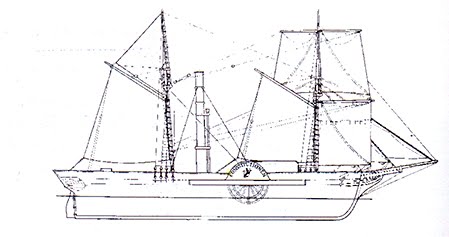
    The King and Queen shipyard to the west of where Globe Wharf stands is identifiable today by the bridge that passes over an inlet which is the remainder of the dry dock that once operated here. The upper part of the yard was taken over by William Elias Evans on the death of Peter Mestaer in 1818. The lower part remained unused for some time but Evans took that over too when his business expanded. He built steamers and carried out repairs. Rankin says that he was a poor businessman and in spite of considerable talent and skill experienced financial setbacks which forced him to give up the lower yard and occupy the upper yard exclusively. once again Rankin describes him as a pioneer who suffered impaired hearing which made him withdrawn and diffident. Between 1821 and 1835 he launched the Lightening and the Meteor (both to the right, above). Both were Post Office packet boats based at Holyhead "which proved for the first time that steamships could operate in the open sea all year round" (Rankin 2005, p.93). In 1826 he launched the Constitutionen for the Norwegian post office (picture left) - the first steamer to operate in the Norwegian fjords. He held the upper yard until his death and it continued to operate as two separate yards afterwards. The upper yard was renamed Prince's Dry Dock and the lower one became King and Queen Dock.

    Packet boats and ships were carriers of people, freight and post. They were designed to be stable in heavy seas and could cover either large or small distances. The requirement for transportation of freight, post and passengers to the US saw the development of routes from London and Liverpool to New York. The importance of the Liverpool route expanded shipping -related activities on the Mersey, offering challenges to other ship building and repair centres. Many European migrants to the U.S. travelled on these packet ships. The requirement for packet ships was a boost to ship builders who had the skills and facilities to meet that requirement. An 1886 article reproduced in the New York times gives a lovely description of the joys of passenger travel on a packet between Liverpool and New York in 1842;
    At the period of which I speak the sailing packets which ran between London and New-York, and between Liverpool and that port, were ships of 500 to 600 tons burden. The staterooms--as the little cabins ranged on either side of the saloon were termed--were below the sea level. They were incommodious, dark and ill ventilated. In fact, the only light they enjoyed was that furnished by small pieces of ground glass inserted in the deck overhead, and from the fanlights in the doors opening to the saloon, and this was so poor that the occupants of the staterooms could not even dress themselves without making use of a lamp. The sole ventilation of them was that afforded by the removal of the saloon skylights, which , of course, could only be done in fine weather. The consequence was that the closeness of the atmosphere was in the staterooms was at all times most unpleasant; while the smell of of the bilge water was so offensive as to create nausea, independent of that arising from the motion of the vessel. In the Winter, on the other hand, the cold was frequently severe. There was, it is true, a stove in the saloon, but the heat from it scarcely made itself appreciably felt in the side cabins. In other matters there was the same absence of provision for the comfort of the passengers. The fresh water required for drinking and cooking purposes was carried in casks; and when the ship had a full cargo, many of these were placed on deck, with the result that their contents were sometimes impregnated with salt water from the waves shipped in heavy weather. At all times the water was most unpalatable, it being muddy and filled with various impurities from the old worm-eaten barrels in which it was kept. Not only was the water bad, but the supply occasionally proved inadequate and when the voyage was an unusually long one the necessity would arise of placing the passengers upon short allowance. There was always a cow on board, but there was no milk to be had than what she supplied, no way of preserving it having then been discovered. Canned fruit and vegetables were equally unknown. There was commonly a fair provision of mutton and pork, live sheep and pigs being carried; but of other fresh meat and of fish the stock was generally exhausted by the time the vessel had been a few days at sea, refrigerators at that period not having been invented.

    Over the next few years other railway were built which connected London and Greenwich.

    From the 1830s ship breaking began to take over from ship building. Many ships that had been built to fight in the Napoleonic Wars met their end in Rotherhithe. The end of the Napoleonic wars in 1815/16 meant that the skills of shipbuilding and repair were now much less in demand.

    It becomes difficult to keep track of the ship yards, their owners and lease holders. Not only were ship yards divided into smaller components or amalgamated into larger enterprises but they were leased out to different owners at different times and owner names changed as new family members joined the business or new partners were included. The uses of these shipyards often changed. Finally, the names of the shipyards were sometimes changed as well.


    Amongst the shipyards which were prominent in the first half of the nineteenth century was John Beatson’s ship yard at Bull Head Wharf (which was renamed Surrey Canal Wharf). It was located near the Youth Hostel and Spice Island/Old Salt Quay where 165 Rotherhithe Street now stands (a modern building). Beatsons purchased warships from the Admiralty for breaking up. Examples include the Treekronen (74 guns) broken up in 1825 the Grampus (5o guns) broken up in 1832 and the Salisbury (58 guns), broken up in 1837, the Charybdis (10 guns) broken in 1843 and the Admiral Rainer, an East Indiaman converted to a prison ship and renamed the Justitia, broken in 1855. They also broke up two of the most remarkable ships that saw action in naval battles: the Bellerapheron and the the Temeraire. The HMS Bellerophon had been built in 1786 and was broken up at Beatson's in 1836. A 74-gun ship, she was built at Frindsbury (River Medway) by a builder named Graves. She was engaged at the battles of The Glorious First of June, the Nile and Trafalgar and was one of the best known ships of the Napoleonic wars. She is now perhaps best know for having held Napoleon a prisoner from July 15th to August 7th 1815 before he was handed over to the HMS Northumberland which took him to exile to St Helena. She was converted to a prison ship in 1824 , when she was renamed Captivity, before being broken up in Rotherhithe in 1836.

    In 1838 the three-decked 98-gun second rate ship of the line HMS Temeraire was purchased for £5530.00 broken up at their yard on Rotherhithe. Built in Chatham in 1798 she had seen action at the Battle of Trafalgar. Like the Bellerophon she had served as a prison ship, and was then used as a receiving ship before being broken up at Rotherhithe. The ship was so famous and such an enormous vessel to travel that far down the Thames that this last voyage attracted crowds of people who gathered to admire and watch her and the event was reported in the London media. She was the largest ship ever to have travelled that far upstream (the biggest ships trusted for construction to private firms were 74-gun ships). She was the subject of Turner’s famous “The Fighting Temeraire”, and even though it seems that many of the details in this painting were incorrect it is still a fabulous testament to a once great ship. Turner may or may not have seen this event, but he certainly captured all the glory and sadness that surrounded her - the unutterable sense of something so magnificent being dragged to a sorry end. I had a copy of the painting hanging on my bedroom wall from when I was sixteen years old.


    There is a sketch of her by William Beatson at her final resting place at the yard, where she looks really very sad (at the National Maritime Museum) Some of her timbers were used to build altar rails, a communion table and two bishop's chairs which were installed in St Paul's Church off Rotherhithe Street (now destroyed). The table and chairs are in are now in St. Mary's Church, Rotherhithe where they were moved after the Second World War.


    The foundations of John Beatson's house at the yard were found in excavations at the site in 2000 (Heard and Goodburn 2000, p.26). It was a Regency style house to the south-west of the wet dock with bow windows and steps leading up to a front porch, the facade of the house facing the wet dock which opened out onto the Thames to the east. Two rooms at the front were separated by stairs going to an upper storey and there were another two rooms at the back. The house had apparently been destroyed by 1894 because it does not appear on the map of that year. Adjoining the house was brick built warehouse which extended to the river. It can be seen, in part, on William Beatson's sketch of the Temeraire. It consisted of four levels each with a large door for unloading commodities. The site plan copied above is published in Heard and Goodburn 2000 (p.29) with the foundations of the house and warehouse clearly shown facing the dock.

    Beatsons were also involved in ship repairs and timber imports, with a big storage building on the south side of Rotherhithe Street, opposite their Thames facing operation. In 1839 they sold 4062 sleepers to Taff Vale Railway.


    In 1838 Bull Head Dock became a general engineering workshop for the Thames Bank Ironworks and in the 1840s the victualling yard was used to expand the gasworks and eventually the entire remaining site was sold to form the Surrey Entrance Lock and the Surrey Basin.


    In 1840 the first postage stamp was introduced, part of a series of reforms to the postal system which standardized and simplified the formerly expensive and complex process of handling and delivering post.

    A report which appeared in 1843 said that 30,000 of Southwark’s residents had no piped water. If you want to see a hair raising account of health and sanitation issues in the Southwark area at this time see Leonard Reilly’s book Southwark: In Illustrated History (1998, particularly p.56-61). Rotherhithe was one of the poorest areas at this time.


    The 1843 map to the left shows the extent of the Rotherhithe docks and ponds at this time. The Grand Surrey Canal basin opened out onto the Thames at the west, and the canal had been widened at its northern end to form the Grand Surrey Inner and Outer Docks (the latter later becoming Russia Dock and now incorporated into the main thoroughfare through the Russia Dock Woodland). Greenland Dock to the south was half its present size with the Surrey Grand Canal passing across its end. The East Country Dock had been built in the early 1800s over 5.6 acres on land now covered by South Dock. The other docks, connected to Greenland Dock which had access out onto the Thames to the east of Rotherhithe are marked simply as the Commercial Docks on the map. They were, heading north, Norway Dock (today a housing development built into the shallow remains of the dock called "The Lakes"), Lady Dock, Acorn Pond and Lavender Pond.

    The dockland areas of Rotherhithe were now increasingly focused on timber and grain. Timber ponds were used as part of the timber processing system. The timber, imported from Canada and the Baltic, was floated in the ponds in order to remove sap from the wood. Open sided sheds were constructed in order to store the timber. Grain also required dockside storage and granaries were built to accommodate it.

    As well as ship building, maintenance and repairs around the edges of Rotherhithe and commodity handling in the centre of Rotherhithe there were numerous supporting businesses in the area. On the river front along the short section between King's Stairs to Elephant Stairs Humphrey (1997, p.41) says that there were 4 mastmakers, 1 shipmaker and 2 shop's blockmakers. Rope makers worked inland because of the space required for rope production but there are deeds in the Southwark Local Studies Library for one between Rotherhithe New Road and Southwark Park Road. A look at the 1843 map of the area shows rope walks at Bermondsey Wall East (formerly Rotherhithe Wall), to the west of Marigold Street.


    Humphrey (1997) says that in 1843 the Commercial Dock Company was paying around one fifth of the parish's rates.


    One of the most remarkable feats of the early 1800s in London was the design and construction of the Thames Tunnel. In 1842 the Brunel engine house was built and in 1843 the Thames Tunnel opened. The Brunel engine house, now a museum, provided a steam pump to remove water from the Thames Tunnel. It was restored in the late 1970s with a replica of the cast iron chimney added in the early 1990s. The shaft of the Thames Tunnel still survives and when work on the East London Line is completed in 2010 should be opened, once more, for visitors to view in person.

    By the mid 1840s there was a clear dichotomy in the shipping activities in Rotherhithe between businesses operating on the Thames fringes of Rotherhithe and those operating in the expanding dock system within the centre of Rotherhithe. Ship builders were building a mixture of wooden, composite and iron ships but ship construction was being gradually replaced by repairs, maintenance and ship breaking. The docks mainly dealt in the handling of commodities - particularly timber and grain.


    References in this post can be found in the site bibliography at:
    http://russiadock.blogspot.co.uk/2008/05/rotherhithe-bibliography.html