Showing posts with label Social housing. Show all posts

Friday, October 23, 2015

John Randall's 1797 HMS Acasta built at Nelson Dock, Rotherhithe


Model of HMS Acasta 1795. Photograph taken
in the Museum of London Docklands.
HMS Acasta was built in 1797 by John Randall at Nelson Dock in Rotherhithe (265 Rotherhithe St, London SE16 5HW).  Nelson Dock (at the time known as Cuckold's Point) is unique in being the sole surviving ship-builders' dry dock in Rotherhithe, preserved in the grounds of the Hilton Hotel. Randall was by no means the first tenant of the dock, which had been occupied since at least 1687.

In the late 18th and throughout the 19th Century Rotherhithe's river front was dotted with these small ship-shaped docks and their yards.  Some were used exclusively for private contracts, but the main form of income came from the Royal Navy and the East India Company.  Although first and second rate ships of the line were built in the Royal docks, third rate ships and below were farmed out to private ship builders to Royal Navy designs, sometimes under they eye of a Royal Navy surveyor.  The hull and its interior fittings were the job of the sub-contractor and ships were usually taken elsewhere to be fitted with masts and rigging and, at another location, with armaments.  Rotherhithe had a busy ship building industry and produced vessels of all sizes from the 17th Century onwards.  The first ship that I know of to be built for the Royal Navy in Rotherhithe was the fourth rate 1654 HMS Taunton.  The last ships to be built for the Royal Navy in Rotherhithe were the steam-powered gunboats HMS and HMS Jackdaw, both launched just over two centuries after Taunton in 1855.

John Randall was a big name in Thames ship-building, building almost exclusively for the Royal Navy.   Randall was based at Nelson Dock in different sections and in different partnerships between 1755 and 1803.  This long period of time is accounted for by the fact that there were two John Randalls, father and son, with the father retiring sometime around 1775.  John Randall Senior was trusted with many high profile ship builds, including a number of prototype designs.  John Randall, father and/or son, had yards at both Nelson Dock and Greenland Dock.  Although most ship building, like later dock work, was supplied by casual labour, the bigger ship builders would sometimes provide tied housing for their more important employees, and at some point the Randalls provided housing of this sort along the passageway now known as Randalls Rents. 

A view of Cuckold's Point, where Nelson Dock was
located.  By Samuel Scott, c. 1750-60
Business partnerships into which the Randalls entered included Randall, Grey and Brent and later Randall and Brent,  but at the time of Acasta's build the lease of Nelson Dock is listed simply under John Randall Esq, probably John Randall Senior's son.  Given that John Randall Senior is thought to have retired in around 1775, the Acasta contract must have been made with John Randall Junior.

In 1802, only five years after Acasta's launch, the Peace of Amiens provided a pause in the wars with France, and new ships were no longer required, causing shipyards to drop wages and shed employees.  This resulted in strikes and escalating violence.  Writing in 1907, Canon Edward Josselyn Beck tells a really tragic story of the younger John Randall, writing in his excellent book Memorials to Serve for a History of the Parish of St Mary Rotherhithe (1907):
In his time, the shipwrights mutinied, and not only refused to work themselves, but laid violent hands on those who were sent to work in their place.  This worthy man entreated them to desist and return to their duties, but in vain.  And being himself struck by one of his workmen he retired from the scene and was so greatly distressed at the events he had witnessed that he throw himself out of his window and was killed by the fall." 
Randall had already had a thoroughly bad year by this time (the summer of 1802), his business being the centre of a scandal surrounding the build of HMS Ajax, which found Randall and Brent being taken to court (and which I'll cover on a future post).  It is certainly clear from the records provided by Stuart Rankin, taken from the Rotherhithe Poor and Parish Rate records, that Randall and Brent Esq and Company was ended in 1803, and Messrs Brent were now listed at Nelson Dock instead.

HMS Acasta was built for service in the French Revolutionary Wars (1792-1802) and later saw action in the Napoleonic Wars that followed immediately afterwards (1803-1815).  According to Rif Winfield, she was a 5th rate frigate fitted with 40 guns on two decks, built to the design of Sir William Rule.  She was the first frigate to have 30 main guns (18 pounders) on her upper deck.  She was launched on the 14th March 1797, having been fitted out in Deptford.  Her first captain was Richard Lane and her first long distance voyage was to Jamaica in 1798, where she immediately took several privateers.

Frigates had been in use in the Royal Navy since the mid 1600s.  The term was applied to a variety of designs but the role of the frigate was always the same - to move at speed, with sufficient fire-power to defend herself and cause problems for others, but not as well armed as much slower but larger warships.  They were classed as fifth or sixth rate ships, depending on the number of guns they carried.  Frigates were used as scouts for the main fleet, and in battle they would assist disabled ships and take command of captured ships.  She could also take on ships of comparative size and fire-power.  Independently, they were sent to foreign seas to capture pirates and foreign privateers in order to protect British commerce.  The 28-gun ships were phased out during the early 19th century - in 1794 there were 22 of them but by 1814 there were none remaining in service. 

HMS Acasta is in the foreground in this painting of the 1806
Battle of San Domingo. By Thomas Whitcombe, 1817,
National Maritime Museum.
Rather than going through the fine details of Acasta's past, I thought I would pull out some of the more interesting features of her career.  There is very little point providing a blow by blow history of the ship here here because she has been so thoroughly covered on the HMS Acasta page on Wikipedia, with plenty of references to The London Gazette, so readers are referred to that article for the details.  Details of Acasta's ship's crew are also available, together with her vital statistics and a year by year chronology of her activities and naval engagements on the HMS Acasta website: http://www.hmsacasta.com/p/ship.html.  However, there are some features of her career that merit further inspection.    

First, it is worth noting a recurring success story in her career that says a lot about maritime preoccupations during 18th Century naval wars.  Anyone who has read any of the Jack Aubrey books by Patrick O'Brian will be familiar with the concept of prize money.  It's a bit like banking bonuses today - ships' captains were encouraged to capture opposition ships so that the could be reprocessed, either used for parts (particularly their guns) or renamed and re-employed in the Royal Navy.  Privateers were a favourite target of Royal Navy ships. Privateers were ships authorized by governments to target naval vessels whilst not being naval ships themselves.  They were never employed in naval engagements but were highly effective as adjuncts to naval activities because their main role was to cause disruption.   Many naval and privateer ships carried valuable cargo, and this too featured in the reward system of prizes.  Prizes were split unequally between the crew members, and it was a significant motivation to sailors, many of whom had been pressed into service, to safely secure opposition ships rather than destroy them. Rewards could make crew members very wealthy.  Acasta is remarkable for the number of prizes that she won, described on the above Wiki page.  Well worth a read.

It is also worth drawing attention to the fact that she underwent surprisingly few refits.  All ships of the line that were engaged in active service went through a hard live.  Made of wood, powered by sail, and held together by rope rigging, they were highly vulnerable not only to fire-power but also to the weather and natural decay, as well as the effects of wood-consuming organisms in the sea itself.   However, in her 24 year career Acasta was apparently brought in for one major refit in Portsmouth, in 1802, which probably had more to do with the temporary peace afforded by the Peace of Amiens, which provided a brief pause in hostilities.  War broke out again in 1803.  HMS Acasta was then paid off in both 1811 and then 1815, and at both times her crew would have been paid, free to find other ships on which to work, and the ship would have been repaired and refitted for whatever future service awaited her. 

Acasta was broken up at Woolwich in 1821 after 24 years of service, which is not a bad life span for a wooden war ship of the period.


Plan of HMS Acasta on the HMS Acasta website.


Sunday, March 1, 2015

A brief history of Redriff Estate from 1931 - 1990

The area now occupied by Redriff Estate as it was
in 1914, with rows of terraced housing.  The Ship and
Whale public house, picked out above in dark
purple, is still open for business today.
Up until this point I have focused mainly on commercial buildings that were erected at the turn of the 20th Century.  But even though much of the older housing has been demolished, Rotherhithe is full of residential architecture - it's the main sort of building put up here since the First World War, and following the extensive destruction during the Blitz of the Second World War.  Much of the residential property built in the inter-war years was social housing, and there is a lot of it in Rotherhithe that survived the Blitz.

Before I start, I know that Redriff Estate has a great many residents living there today, and I'm sure that many have done a lot of research of their own and found out much more than I've been able to in the short time that I've been looking into it. I have doubtless missed out some important information but I have really done my best to keep the facts in order.  Redriff Estate has a splendid history, so please get in touch if you know of anything that you think should be added. One of the nice things about publishing on the Web is that everything can be updated! 

Redriff Estate, highlighted in purple, on a
1940 map of Rotherhithe
In the early to mid 1800s the site of the estate had been earmarked for high quality housing by the Bedford Estate Trustees who owned the land.  Some of those properties been built, but the surrounding dock industries, with its associated sounds and smells, made it an unattractive location in which to live. Instead, properties related to Greenland Dock grew up, including down-market houses, workshops and small shops. One of the workshops was the last figurehead carver in Rotherhithe. The above map shows what the area looked like by 1914, with terraced houses lining three roads:  Elgar Street, Odessa Street and Derrick Street in the middle. Although many of the buildings had changed by 1930, the road layout was still the same. Buildings, homes, shops and workshops that had stood where Redriff Estate now lies were destroyed in 1930.  F. Mary Wilson, the Head Teacher of Redriff Primary School remembered the area before the estate in her book Between Bridgers:  "The Odessa Street Clearance Area, so called by the Bermondsey Borough Council swept away many alleys, courts and tenements.  Such ancient names as Derrick Street gave way to Gulliver Street.  Sedgers Buildings, York Cottages, Gilbert Terrace, and the local bakehouse, all became locations of the past." Stuart Rankin says (in his Maritime Rotherhithe History Walk B) that "many proved to have been built using old ship's timbers."  One of the surviving buildings from the former residential area was the Ship and Whale public house which was built in the mid/late 1800s and is still there, serving Rotherhithe residents as it has for over a century (covered in an earlier post).

Redriff Estate on a modern
map of Rotherhithe
The Redriff Estate was put up in the 1930s. Derrick Street was effectively eliminated, Redriff was the traditional name for Rotherhithe, a suitable name for the large estate, but it was also the name of the nearby wharf (shown on the 1914 map above, now the site of the modern New Caledonia Wharf development).  Work began in 1931 and the complex was completed in 1940. Odessa Street and Elgar Street were retained, but Derrick Street was no longer required as a street and was subsumed into the development.  It is mentioned in several places that dignitaries from all over the UK attended the opening of such an enlightened project, but I have been unable to find out who they were.

The Redriff Estate was made up of eight blocks, but they differed from one another in size, as can be seen in the aerial photograph from the early 1950s below.  The three- and four-floor development stretched over several acres, with extensive communal facilities and outdoor areas.  

Redriff Estate in 1952. From the
"Britain From Above" archive, EAW045684
Although built with economies of scale in mind, to a single design concept throughout the site, it was conceived as anything but the faceless blocks associated with the 1960s. Designed to be both attractive and to house a community rather than just large numbers of people it had personality and colour, even before the modern paintwork.  All made of dark yellow and red brick, with white-painted upper levels, each block is slightly different, with decorative brickwork touches.  One of the blocks features a  wonderful soaring Art Deco arch through Walker House, picked out in black brick work, which is both charming and impressive. Pop Art supremo Roy Lichtenstein once called Art Deco the Art Nouveau for the home.

Stuart Rankin says that although electricity was now standard in most new homes, these were built with gas lighting and solid fuel cooking ranges, probably due to the fact that the nearest electricity works at Spa Road in Bermondsey being at full capacity.  The local gas supply station in Rotherhithe didn't shut down until 1956, and had supplied houses with lighting and heating for over a decade.  The Council gave residents the option to buy furniture for their new homes by adding small additional payment to their weekly property rental.

Redriff Estate in 1959. Photograph from Stephen Humphrey's
book Bermondsey and Rotherhithe Remembered.
Wonderful cars, but what on earth is that pile of
debris on the corner that seems to be drawing such
attention from both street and 2nd floor level?
The site, including 126 flats, was badly damaged during by fires during the bombing of the 7th September 1940, the first night of the 39-day London Blitz. The bombs hit Rotherhithe so badly that the fires were uncontrollable and had to be left to burn themselves out, largely due to the intensity of the fires in the timber yards. The area was evacuated and much of the Downtown area of Rotherhithe was lost in the blaze.  The 1838 Trinity Church, which had served the community for over a century, was one of the first churches in London to be destroyed by German bombing.  It was lucky that any of it survived at all, as much of Downtown was eradicated by the fires.

An eye-witness account was given by Tom Winters, a boy at the time of the Blitz.  He and his family had lived in the Holyoake Estate but when this was bombed they moved to Catford to live with his grandmother.  When this property was bombed four weeks later, they were re-housed in 136 Redriff Estate, a four room apartment on the ground floor.  He and his brother shared a bed in one room, whilst his parents and his two younger sisters shared another room.  Various accounts of life on the Redriff Estate during the Blitz by Tom Winters are reproduced in "The Longest Night: Voices from the Blitz" by Gavin Mortimer.  There is far too much to reproduce here so if you're interested in life in Rotherhithe at this time, it's well worth the purchase price.  Here's a short taster from the book, recounting Tom's experiences:

They heard the bombs come down, pushing the air before them.  Tom counted six, each one "absolutely terrifying."  "The noise quickly developed from the whistling down sound to a rushing ugly noise like an express train about to hit you."  Everyone in the flat threw themselves under the large wooden table in the centre of the room:  "We arrived in an untidy heap under the table at the same time as six bombs crashed into Redriff Estate" recalls Tom.  "Not with individual explosions but seemingly one terrific, almighty and terrible ear-piercing bang."

A harrowing story on the BBC website by another resident, Kenneth Alford Haines, who was also a boy at the time, says that many of the Redriff Estate residents perished after they had been evacuated for their safety to the local Keetons Road School:

As we got closer, we heard the faint sound of machinery, but didn't see a soul until we rounded the corner into Keetons Road where we were met with a scene of devastation.  The big school wasn't there anymore, just a few bits of wall and great heaps of rubble with clouds of dust rising from the activity of the Rescue Squads with their gear and lorries. A Rescue Worker stopped us getting any closer, and turned us away. We were horrified, the school had obviously suffered a direct hit when full of people.  We afterwards learned that close to 400 people had been killed there, some of them our neighbours and schoolmates, but mostly they were people who'd been evacuated by coach from the council estates close to Surrey Docks, mostly blocks of flats in the Redriff Road area, which was known locally as "round town". Many dockers and their families lived there.
Redriff Estate squat, 1983,, from
Ben Trovato's article "Squat
Property"
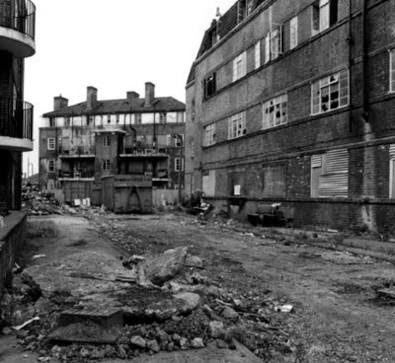
Post-war repairs were carried out, and people moved back in.  Photographs of the area in the early 50s shows people milling around, cars parked all along the roads, suggesting a generally well used residential area.  But when the docks began to close in the 1960s and work became hard to find, people moved away to find work, and most of Redriff Estate became derelict.   By the mid 1970s there was an uncomfortable mixture of paying tenants and squatters.  There is a brilliant set of colour photographs on Flickr of the estate in the late late 70s by Dave.P.C. at   (with thanks to @E44Blackwall for sending me the link on Twitter).

Author Ben Trovato, who was then unknown, wrote about inhabiting one of the squats on the estate in 1983, in an article called Squat Property on the Times Live, ZA website.  The link is now dead, and I've been unable to find a copy of it anywhere else, but I copied an excerpt from it at the time, which is sufficiently evocative of the article as a whole:
We’ve already picked out a ground-floor flat. Sticking to the shadows, we reach the door and go to work on the lock. It takes three minutes for the hacksaw blade to snap. The crowbar is no help. Nor are the screwdrivers. This leaves the sledge hammer. I pick it up with both hands and am about to deliver a death blow when a police siren cuts through the fog. We grab the tools and make it to the stairwell just as a sleek, white Rover veers into the estate. Cops pile out of it and begin searching an area 50m from us. They leave. We exhale. Ten minutes later, the lock shatters and the artist uses his Doc Marten boot to open the door. We replace the lock and become the legal occupants. Vote Labour. It seems too good to be true. A clean three-bedroom flat with a view of the Thames for which no rent will ever be paid or demanded. Sure, there is no electricity, gas or hot water, but we can’t exactly complain to the council.  After weeks of living by candlelight, which doubles as our central heating, we meet a gentleman who shows us how to bypass the meter for the price of a bottle of rum. Rotherhithe is a rough area, no doubt about it. There are half a dozen heroin dealers living within a five minute walk of one another. Some squatters have their cars set alight at night. Punks, skinheads and anarchists share an uneasy existence alongside angry, rent-paying Cockneys. These legitimate tenants hate us for living in flats identical to theirs, but for free. I come home one night to find “Squatters Will Die” spray- painted across the door.

Even the squatters left eventually, as described in an article by Sonia Soltani on the building.co.uk website entitled How do we get from this ...... to this?
Rotherhithe's derelict Redriff Estate, before
its 1980s rebuild.
The Redriff Estate on the fringe of London Docklands had all the problems of a typical rundown estate - and worse. When even squatters abandoned the derelict estate in the early 1980s, the alarm bells rang. Built around the perimeter of the Rotherhithe peninsula in south-east London in the 1930s as model local authority rented homes for dockers and their families, the Downtown Estates, to which Redriff belongs, were in a dire state 20 years ago, little more than a collection of burnt out shells. The decline of this part of the London Docklands after the Second World War was such that its only claim to fame was being used as a setting for war films such as Full Metal Jacket.

It was also used in the 1986 pilot episode of the 1980s television series London's Burning - photos of which are on Twitter at https://twitter.com/e44blackwall/status/526803231566229504.

However, as part of the London Dockland Development Corporation plans for a regenerated Rotherhithe, the entire estate was refurbished, as the article goes on to explain:

In the 1980s the dramatic juxtaposition of new upmarket private housing in London Docklands with the obvious poverty of the other docklands boroughs led Southwark council to transfer its vandalised squats to the London Docklands Development Corporation. This allowed the LDDC, local housing associations and the private sector to create a major mixed-tenure scheme. The amount of money poured into the project revealed the faith in the area's potential. The £55m Redriff Initiative on the Redriff Estate benefited from the largest ever single grant from the Housing Corporation - £22m. The rest of the funding came from the LDDC, a combination of public and private sector investment and Southwark council. A client consortium was set up comprising six locally based housing associations (South London Family Housing Association/Crystal Palace HA, Shackleton HA, Wandle HA, Housing for Women, Carr-Gomm HA and Peckham and Dulwich HA) together with Southwark council, the Housing Corporation and the LDDC. 

Although one block was demolished, formerly located on Odessa Street, 229 homes were created on the Redriff Estate for rent and shared ownership. A school and community facilities that had been located in the centre of the estate were demolished and this area was landscaped with additional car-parking areas added.  Part of the job was given to a private company:  Barratt East London, established in 1983 under project manager Alastair Baird.  It's nice to be able to credit Barratt with something good for a change (don't get me started on Ontario Point again). Sonia Soltani quotes Baird's recollections of the work: 
"We cleared the wreckage, from burned out cars to discarded drug needles, and then stripped out the shells, including all walls that were not load-bearing, which gave us the chance to reconfigure the flats. They were then re-roofed, re-floored and totally refurbished to provide modern conveniences such as fully-fitted kitchens and en suite bathrooms, increased levels of thermal and sound insulation, full heating, modern integrated wiring, and disabled facilities and access where required."

Bow-ended balconies were added, outside areas landscaped and parking space was expanded. Bright blue, red and green paint cheered things up considerably, nicely complementing the dark yellow brick.  
Barratt was fortunate with Redriff in that the buildings are traditional brick, rather than the sometimes more problematic system-built concrete. Also, there were no structural problems to contend with. Baird points out that all the original external features remained: "You've got character here. We've kept the character of this. It's better if you can keep the original features."

Flats are now occupied by both council tenants and private owners.  Wandering through on a sunny day, Redriff Estate has a range of colours and shapes to it that many estates simply lack.   It contrasts notably to the bland modern block opposite, New Caledonia Wharf, which lacks any of the warmth and variety of the far older Redriff Estate. 


The corner of Walker House
Photograph by Andie Byrnes


Walker House

Walker House arch

Elgar Street flats, showing decorative
brickwork. Photograph by Andie Byrnes


The corner of Gulliver Street and Elgar Street. 
Photograph by Chris Lordan,
under Creative Commons licence.


Particular thanks to the websites UK Housing Wiki and
Sonia Soltani's article
How do we get from this ...... to this?