Showing posts with label Barnard. Show all posts

Tuesday, June 17, 2014

The Grove Street yard under Barnard, Dudman and Adams 1763 - 1795

The Grove Street Yard in 1827, 32 years after the death
of William Barnard, but showing its position in
relation to Greenland Dock (just on the edge of the image
at the top) and the victualling offices to the south.  It is
still referred to as Mr Dudman's Yard, after Barnard's
senior partner.  Thanks to the worldgeneaology.blogspotblog for
posting the image
.
The Barnards were one of the most prominent of Rotherhithe'S ship builders. The earliest of their enterprises on the Thames began with William Barnard and his partners, building ships mainly for the Royal Navy and the East India Company.   Although it was possible to determine which ships were built in the Grove Street yard when it was the sole base of operations, this detail became lost when William Barnard purchased a lease on the Deptford Green yard.  None of the ships built by the Barnards are assigned to either of the yards in the documentation, making it impossible to determine which yard produced which ships.

The Grove Street yard was just over the former border between Surrey and Kent, now the border between Rotherhithe (Southwark) and Deptford (Lewisham).  That border lies immediately upriver from South Dock, and follows a line that used to be marked by a river called the Earl's Sluice, now covered over and emptying into the Thames under a yellow sign that reads "Sewer Outlet 30 metres Out From This Board"  Perhaps more tangibly, there is now a piece of freestanding wall along that section of the Thames Path that marks the former boundary, and was one of the walls of the bridge that crossed the Earl's Sluice.  Even though the site is strictly speaking off Rotherhithe turf, I've included it because it is so near that it makes precious little difference.

In the 18th Century, when William Barnard and his partners began to work at the Grove Stret Yard, it was located not far from the Royal Dockyard and was sanwiched betweeen the victualling office and Greenland Dock, making it a very convenient location. It was  bound to the south by the victualling offices, to the west by Grove Street itself and to the north by Plough Way, which terminated in the George Stairs.  Grove Street still exsits, but the yard is long gone.  The George Stairs also still exist, but they have been replaced probably several times since the 1700s, in the original location.

From John E. Barnard's "Building Britain's Wooden
Walls" 1997. Page 52, showing the large wet dock
at the Grove Street yard.
The Grove Street yard was the first presence of the Barnards into the Thames area as shipbuilders.  Formerly, John Barnard had been a shipwright and shipbuilder in Ipswich and Harwich.  His son, William (born in 1735) followed in his father's footsteps and may have served his apprenticeship at Deptford.   He worked at the Harwich yard from around 1756, during the Seven Years War.  He married his wife Frances in 1760.  In partnership with William Dudman, an experience shipwright and shipbuilder 15 years his senior, he built seven vessels at his father's Ipswich yard

In 1763 William Barnard, William Dudman and a third partner, Henry Adams who owned a yard in Hampshire, took a 30 year lease on the 9-acre Grove Street yard with its 450ft frontage, also known as the Lower Wet Dock and later the Dudman yard.  It had one large wet dock, two dry docks and three building slips, as well as a house, and was therefore well equipped for the newly established business. William Dudman and his family took up residence in the yard's residential building.  The business opened in 1764, and appears to have operated under a number of names.

French Corvette Boyonnaise boarding HMS Ambuscade
during the action of 14th December 1798
by Louis-Philippe Crépin 1798
(Source:  Wikipedia)
The lease on the yard had been taken out for a 30 year period, during which the partnership was maintained.  For the first decade the partnership specialized in East Indiamen, althouth they also received Naval contracts.  Between 1763 and  1772 alone they launched seven East Indiamen - Ponsbourne, Grangy, Bridgewater, Resolution, Royal Henry, Royal Charlotte and Ankerwick.  In his 1997 book "Building Britian's Wooden Walls" John E. Barnard says that it was customary for East Indiamen to to return to the yard that built them for refitting and repairs, so each ship built represented ongoing business for the yard. In 1771 the Navy began to once again allocate contracts to private shipyards, and the Grove Street Yard received orders for two 74-gun Ships of the Line named Hector and Sutlan

In 1772 the 52 year-old William Dudman died, leaving the 37 year-old William Barnard in charge.  He seems to have recovered quickly from the loss of the senior partner, overseeing the buils of 12 ships between 12 vessels, which included 8 naval contracts. The Naval vessels built between 1771 and 1779 were Ambuscade (a 5th rate / 32 gunes), Hector (a 3rd rate / 74 guns), Experiment (a 4th / 50), Hound (a 40-gun sloop), Pelican (a 6th / 24, which has a role in the Mutiny on the Bounty story), Zephyr (a 14-gun sloop) and Pandora (a 6th / 24).  Hydra and Zephyr were both purchased on the stocks.

Between 1777 and 1778 four East Indiamen were built at Grove Street:  Mount Stuart, Royal Admiral (later converted to a Naval 3rd rate), Royal Bishop and General Barker

Painting by Louis Le Breton showing Tonnant in the
foreground and Majestic in the background.
National Maritime Museum (Source:  Wikipedia)
At some point, William took William Dudman's son John into partnership, allocating a one fifth share to him.  John had worked at the Grove Street Yard, and continued to live in the family home at the yard.  In 1779 William Barnard rented, in his own name, a yard in Deptford Green in Butt Lane, another substantial enterprise with a dry dock and two slips as well as two dwellings and gardens.  His family moved there to make their home in the bigger of the two dwellings. The lease originally ran until 1786 but was renewed at that point to run until 1859.   However, he continued to run the Grove Street Yard.  It is at this point where it becomes difficult to tell which yard built which ships; although Naval vessels were recorded according to yard, the East Indiamen were not.  It is known that eight naval vessels were built at Grove Street during this period:  Orpheus (a 5th rate / 32 gun), Africa (a 3rd / 64), Andromache (a 5th/ 32), Carnatic (a 3rd / 74), Iris (a 5th / 32), Solebay (a 5th  / 32), Majestic (a 3rd / 74) and Orion (a 3rd / 74). 

A story that John Barnard tells in Building Britain's Wooden Walls shows how private shipbuilders were at the mercy both of the Navy Board and the political situation.  The conclusion of hte American War of Independence in 1771 and the subsquence Peace of Paris in 1783 meant that naval ships were no longer in such high demand.  The Deptford Green yard had two ships ready for launch in late October and late November 1784 respectively on their slips, but the Naval Board wanted to delay the launch until 1785, which would have tied up the yard's slips and prevented future shipbuilding work at the yard.  A flurrly of correnspondence followed, and it was eventually agreed that the ships could be launched, freeing up the slips, but that payment would be delayed until a later date.   Although Tremendous was launched on the date originally planned, Majestic remained in situ until February 1785.   These and the 1785 Zelous (Deptford Green) and the 1787  Orion (Grove Street) were the last ships to be luanched for the Navy by William Barnard, but he continued to build East Indiamen - 28 in both yards between 1780 and 1790.

William Barnard became an expert on the subject of rescuing ships that had run aground, a sort of 18th Century salvage expert.  In the Philosophical Transactions of the Royal Society of London he wrote An Account of a Method for the Safe Removal of Ships That Have Been Driven on Shore, and Damaged in Their Bottoms, to Places (However Distant) for Repairing Them. By Mr. William Barnard, Shipbuilder, Grove Street, Deptford; Communicated by Nevil Maskelyne, D. D. F. R. S. and Astronomer Royal (January 1, 1780), an insight both into the task that he undertook on this occasion, and into the language of the day.

Model of HMS Orion at the Vancouver
Maritime Museum (photo by "The High Fin Sperm Whale"
(Source:  Wikipedia CC BY-SA 3.0).
John Barnard also tells the sad story of the last five years of William Barnard's life, which was marked by conflict with his partners, a disagreement that reached the courts.  The least on the Grove Street yard was due to expire on 25th December 1793, and both Henry Adams and John Dudman wished for renewal;  Barnard, however, wished to dissolve the parnership and work alone at his Deptford Green yard.   He wrote a letter of resignation to the other two partners but this was contested by Adams who claimed that Deptford Green was part and parcel of the business owned by the partnership.  Barnard was forced to take the matter to the Court of the Chancery to have his case heard.  Although the case was settled out of court in February 1794, and the partnership had been dissolved by the time the Grove Street yard lease was due for renewal.  Few ships were built during this period, and Barnard died in March 1795.

William Barnard was survived by his wife Frances and their two sons, William and Edward George (shipwright apprentices), and three daughters, Ann, Frances and Elizabeth.  The business passed into their control and they continued to run it out of Deptford Green and later the former Wells yard north of Greenland Dock in Rotherhithe.  Frances eventually died in 1825 at the age of 88.


The story of the Barnards in Rotherhithe continues, already covered on an earlier post.

Some of the ships mentioned in this post will be looked at in greater detail in future posts.


As with the previous post, this piece was almost entirely dependent upon the research of John E. Barnard, captured in his book Building Britian's Wooden Walls:  The Barnard Dynasty c.1697-1851 (Anthony Nelson 1997).


Saturday, November 16, 2013

Shipbuilding at the Barnard's Wharf site c.1750 - 1840

This turned into quite a long piece, so I have divided it into different sections:

  • Introduction
  • Thomas Stanton
  • John and William Wells
  • The Barnard Family
  • After Shipbuilding
  • Summary of the key dates


Introduction 


The site today, with Surrey Docsk Farm at the
top of the former shipbuilding site, and
a housing estate at the lower end of the site.
Courtesy of Google Maps
The Surrey Docks Farm site was part of the area over which three different families of shipbuilders made ships for the Royal Navy and the Honourable East India Company. The site extended from the Acorn Stairs, at the northern end of the Farm's Thames frontage, and extended downriver to where the Scotch Derrick is now located.  It was a considerable area and is often referred to as Barnard's Wharf, after one of the families that built ships on the site.  The Acorn Stairs were named after a local pub, which was established in around 1761 and closed in 1941 and always sat at the back of the shipyard. 

Untangling the various ship building activities at the site has been an interesting challenge. Different versions of the same story, and maps with out of date information have not helped, and the fact that the same first names were handed down within shipbuilding families from generation to generation causes considerable confusion, but the following seems to provide the main gist of the story. Stuart Rankin's Shipbuilding in Rotherhithe - Greenland Dock and Barnard's Wharf (1997) has been very useful and John E. Barnard's Building Britain's Wooden Walls has been invaluable for the Barnard years.  Still, some confusion remains and where I've been unable to clarify a point I've made that clear.

If the shipbuilders based here over the years had built ships exclusively at this site, matters would have been a lot easier, but successful shipbuilders did not confine themselves to one site, and either owned premises elsewhere as well, or rented docks from other builders when they had too many orders to manage at one site.  It is sometimes difficult to work out who was working where at what time, and which ships were built at which yards.

The site is the subject of research by the Surrey Docks Farm Heritage Project headed by Germander Speedwell, and I am enormously grateful to Germander and the rest of the team for expanding my horizons in so many ways!  Thanks particularly to Mary Budd for pointing out a missed piece of information.  Thanks guys.


Thomas Stanton 


HMS Carcass, built by Thomas Stanton, and
HMS Racehorse
None of the maps that I have seen give the that stretched downriver from the stairs a name until Thomas Stanton took the yard in the mid 1750s, leasing it from the Bedford Estate. Thomas Stanton was the first shipbuilder at the site, although by no means the first in Rotherhithe. The earliest yards had been established downriver around Deptford. Barge and shipbuilding yards had extended slowly around the perimeter as London ship and barge building, refitting and repairs became increasingly important, and all available areas of the Thames frontage were snapped up.

Not much is known about Thomas Stanton, although Stuart Rankin's research suggests that he was the manager or foreman at a Captain Bronsden's shipyard at Deptford Grove Street.  Rankin suggests that he achieved the means to establish himself at Rotherhithe by joining forces with business partners in joint shipbuilding enterprises.  He is listed, for example, as a partner for HMS Chester which was ordered from "Bronden, Wells and Stanton."  He was at the Rotherhithe yard by 1754.  The name by which the yard was known at the time is unknown, being marked simply as "shipwrights" on early maps of the area.  It is now usually known as Barnard's Wharf, due to its association with a later ship building family.  Rif Winfield lists the builders of Carcass as Stanton and Wells, which differs from other sources, but it is entirely possible that the Wells shipbuilding company (probably the Wells involved in the above-mentioned construction of HMS Chester), which took over the yard after Thomas Stanton, was involved in her construction.  

Thomas Stanton appears to have had some sort of relationship with the Wells family, who had had connections with the area since at least the late 1600s when they helped to finance the Howland Great Wet Dock (the first iteration of Greenland Dock) and had established their own yards at the Dock's lock gates. The Wells family had a broad portfolio of interests, investing in all sorts of different property and ship-related businesses, and it is possible that they had either an ongoing or ad hoc financial interest in Stanton's business.  They certainly collaborated on the construction of ships at Stanton's yard.   Indeed, a recent site plan owned by the Bedford Estates and drawn up by them, discovered by Mary Budd at the Metropolitan Archives, which shows considerable detail, and has been tentatively dated to the 1740s shows the site as Wells and Stanton, indicating that Stanton may always have had a solid business relationship with Wells.


On his own, Stanton appears to have produced a number of ships at the site, both for the Royal Navy.   Examples are HMS Carcass on which Nelson once served (which I covered on an earlier post), HMS Stag (launched 1757), HMS Active (launched 1757) and HMS Ferret (launched 1760).  In collaboration with the Wells family he produced Hunter (1755), America (1755), Essex (1759), Lynx (1760) and Augusta (1759).  All ship has been data taken from Rankin 1997.

John and William Wells 


The East Indiaman True Briton, launched 1860
Probably from as early as the 1500s the Wells family had interests in Greenwich and Deptford as well as Rotherhithe but their shipbuilding activities only began at around 1635, in Deptford.  Their connection with the Howlands of Streatham, who were involved East India Company led them to build a number of ships for the Howlands and, on the marriage of Elizabeth Howland to the grandson of the first Duke of Bedford gave them the opportunity to invest in the Howland Great Dock in Rotherhithe, and led to the Dukes of Bedford commissioning ships from them.  Rankin's research suggest that many Wells ships were probably built in yards immediately in the vicinity of the entrance to the Howland Great Dock from around 1700.  The Greenland yard supplemented the Wells's Deptford interests.  However, the Greenland yard seems to have been abandoned at some stage during the first half of the 18th Century.   There are indications that Rotherhithe became important to them once more after 1760.  By 1760 the Greenland Dock yards were being leased by the Bedford Estate to the successful shipbuilder John Randall, whose main base was at Nelson Dock (where the Hilton Hotel is now located), so the Wells family had to look elsewhere for a base.  It is probable that they already had a firm connection with Thomas Stanton. The above-mentioned 1740s map of the site from the Bedford Estates archive indicates that a firm called Wells and Stanton had already been established there, but whether the Wells part was actively engaged in shipbuilding at the site at this time or was an investment partner is unknown.

Thomas Stanton had been building ships at his yard for 10 years by now, and it is possible that the ties between the two families were leveraged at this point to allow the Wells operation to shift to that site.  Although John and William had left Deptford by 1763, Stanton still held the lease for the Rotherhithe shipyard, so the exact year in which the Wells brothers took over the site is unclear, but at some point in the 1760s they purchased the freehold from the Bedford Estate, so they were clearly intending to stay and expand their operation.  

The Wells brothers were responsible for extending the yard, forcing Queen Street further inland, when it was renamed Upper Trinity Street.  It is this road layout that is still familiar today, extending north from the Acorn Stairs to the pathway just short of the Scotch derrick to the south.  It enhanced the distinctive corner in the road that curves around the Farm before turning again down Rotherhithe Street.  This is shown on an 1813 map that is based on an earlier map by Horwood.

The Thames at Redriff by Thomas Whitcombe.  Philip Banbury (1971)
believes that this is the Wells yard, looking downriver. The
tower of St Anne's at Limehouse is visible to the left.
The Rotherhithe phase ties in with the last generation of shipbuilding in the Wells family.   John and William (born 1761 and 1768) went into the family business, whilst their brother Thomas entered the Royal Navy, where he was sponsored by family connections and eventually became a Rear Admiral.  The Wells shipbuilding dynasty had ended by 1814, by which time John and William Wells had sold out of the shipbuilding trade.  Although no new ships are recorded being built by the Wells brothers at the Rotherhithe yard after 1797, rates continued to be paid until 1805, which argues that some sort of activity was taking place there. 

Between 1758 and 1797 at least 25 ships were ordered for the Royal Navy and the East India Company and Rankin believes that around 77 East Indiamen were built by them.  There is some question over whether a batch of the last of the Wells ships were built at Rotherhithe or Deptford. Although around seven ships are recorded by Winfield and Lavery as being built at Deptford, Rankin was unable to find any record of the Well family owning or leasing a yard in Deptford over the years in which they were built (1795-1797) and believes that these records represent an administrative error.  A few of the ships that were built at the site are HMS Cornwall (launched 1760), HMS Eagle (1771), HMS Thunderer (1783)  and HMS Terrible (1785), all built for the Royal Navy.  For the East India Company the built the East Indiamen True Briton (1760), Grosvenor (1770), Thetis (1786) and Exeter (1792).

The Barnard Family


Map showing the Barnard
Rotherhithe, Grove Street and
Deptford Green yards
There is some discrepancy between Rankin and Barnard over when the Rotherhithe site was acquired by the Barnard family.  According to Barnard, William Barnard took over the site in 1798, purchasing the freehold from the Messrs Wells, but Rankin has found records indicating that the Wells family continued to pay rates on the site until 1805.  As the Barnard shipbuilding records do not specify which ships were built at any of their three yards, it is impossible from the information to hand to work out quite who was doing what at the site between 1798 and 1805.

William Barnard (not to be confused with his son William, who will be referred to as William junior) was a ship builder from Deptford who retained an important Deptford Yard after leasing the Wells yard. The family had originally been shipbuilders based in Ipswich and Harwich, but by 1763 a business in which William Barnard had invested was established at Deptford Grove Street under the management of William Dudman.  On Dudman's death in 1772 William Barnard moved to Deptford to manage two yards - the one he owned with Dudman and Dudman's own yard. Chaos ensued, with legal wranglings and much ill-feeling between the various interested parties.  Barnard established his own yard at Deptford Green although he retained interests at another yard.

To the north of Greenland Dock, in the bend of the road,
the Barnard site is clearly visible in the 1805 map.
Just to the south of Greenland Dock, Grove Street
is marked - this was the site of one of their other
shipbuilding yards. A third was at Deptford Green
.
William died in 1795.  he left behind his wife Frances (occasionally spelled "Francis" on official documents), two sons, William (for the purposes of clarity, William junior) and Edward George, who were apprentices at the time aged 19 and 17, and three daughters, Ann, Frances and Elizabeth.  William's will was very specific - he bequeathed everything to "my beloved wife Frances for her absolute use and benefit."  Frances was 58 at the time of her husband's death.  She moved in 1803 to Mitcham.  These were good years for the yard.

According to J.E. Barnard's book, in late 1798 / early 1799 William junior and his younger brother Edward  purchased the freehold of the Rotherhithe yard from the Wells family, which included 450ft of river frontage and a field on the opposite side of the road, which measured 550ft by 350ft.  It included a large dry dock, a building slip, a mast house and a mast slip and enabled the Barnards to expand their interests into fitting and refitting as well as building.  The wars with France between 1793 and 1802 and 1803 to 1815 ensured the demand for warships kept private yards busy, producing everything from 10- to 74-gun ships.  The East India Company were also expanding, and their demand for ships and fitting services was also high. However, inflation was also a by-product of the wards and this caused problems for all Thames ship builders because the standard payment for ships rarely covered the rising costs, and workers were demanding higher wages.

William junior had a short life, dying in 1805 at the age of 29, leaving a wife, Harriet, and three children, Frances, William Henry and Thomas.  William junior's will, dated 25th February 1805 is somewhat confusing.  It indicates that he has ownership of the yards, even though his father had bequeathed everything to his mother Frances, and she was still alive in 1805.  The will itself left William junior's own half-share in the yard to his cousin Edward Clarke but on condition that if his brother and co-shareholder Edward George wished to purchase the half share within 12 months, he should be able to do so,  Edward George did so, and became the sole owner of the yard at the age of 27.

The Barnard yard in around 1820. Sourced
from Barnard, J.E. 1997
In about 1820 the site was split into two sections, an upper and lower yard, both operated by Barnard interests but owned by Edward George Barnard and let out by him to the family subsidiaries.  The upper yard was registered in the name of F.E. and T. Barnard, the area covered by the Surrey Docks Farm, and was engaged in the manufacture of masts and spars.  The lower yard, in the name of Francis Barnard, Sons and Roberts was the larger of that two, reaching south of there to the walkway to the Thames Path where the Scotch Derrick is now located.  Banbury refers to a magazine article sating to 1826 "which says that an Edward Barnard was shipbuilding at Trinity Street Rotherhithe," which but Banbury doesn't say which magazine or whether it is to be relied upon.  It is not known exactly who Roberts was, but he occupied a house in the yard at Deptford Green so was obviously a manager or someone of equal importance.  As with the yards before it, the site extended south of the current Farm site to include land now occupied by the housing estate.

Edward George decided to renew and enlarge the gates of the yard in 1819.  This was subject to consideration by the Worshipful Committee for Improving the Navigation on the River Thames, and although they eventually approved it, it appears that by the time the decision had gone through the process of being considered, Edward had changed his mind and the work was never carried out.  This is possibly because of the changing economic circumstances at the yard.

Following the end of the French wars in 1815, and the East India Company's loss of its monopolies in India in 1813 and China in 1833, the demand for new ships fell dramatically, and these became very lean years for many shipbuilders.  It is quite telling that those that survived were often those that mate the transition to the building of steam ships. As I mentioned earlier, it was a common practice for shipyards to lease space in neighbouring yards and there are at least two examples where local shipyards built their ships at the Barnard site.  Rankin says that there is evidence that Marc Brunel's steamer Regent was built her by J.B. and Thomas Courthope in  1816.

In 1823 a letter from Edward George to the landlords of Deptford Green Yard stated that the docks of Deptford Green and and Rotherhithe were "virtually shut."  J.E. Barnard's book says that the last documentary mention of the Barnard occupancy of Rotherhithe is to be found in the minutes of the Worshipful Committee minutes record danger from an old slipway at the yard - sadly there appear to be no records of what measures were taken to resolve the problem.  However, Rankin also says that Edward George purchased the paddle steamer Ruby from the Admiralty in 1846, presumably to break her up, and there is evidence that John Jenkins Thompson of Horseferry Yard built paddle steamer Banshee here which was launched in 1847.

Frances died in July 1825, having moved to rural Mitcham in 1803, at the age of 88. William's son Edward George eventually became an MP for Greenwich, dying in 1851 at the age of 73.

There is no differentiation in the Barnard records between ships that were built at any of the three yards, Rotherhithe, Grove Street and Deptford Green. All ships were simply recorded as being built at the Barnards' Thames yards, so it is impossible to know which ship was built at which yard and I have not listed any of them here.

After the Shipbuilders 


Shipbuilding at the site ended with the Barnards, but it went on to have a rich history and many different uses, from timber storage, a typical local use of such spaces, to its far less conventional role as a smallpox vetting station.  The Surrey Docks Farm Heritage Project has been investigating some of these latter roles, the results of which are being used for information boards at the Farm.  The following is a very brief overview of some of the uses to which the site was put following the Barnard occupation.

The site in 1843, marking the upper yard
as "Timber Yard"
By 1843 it was marked as a timber yard on the map produced by the Society for the Diffusion of Useful Knowledge.  It had been purchased by the Commercial Dock Company with a view to building a new lock into their enclosed dock system, but this plan was never carried out and the site was used for different activities.  For a long time it was still shown as Barnard's Wharf on maps, but seems to have been renamed Acorns Wharf when it began to be used for the timber trade.  For this trade, it was first occupied by Peter Rolt and then Thomas Gabriel.  The next company, Gabriel Wade and English, specialized in the creosote-treatment of timber, and ran four steam cranes on a network of tracks.  

On the 1868 Ordnance Survey map the Farm site is marked as "Acorn Wharf" with two cranes on the site, with a set of housing marked at the end of the site (immediately to its west), together with a public house, The Acorn.  To its south, a vast timber yard is marked, complete with the surviving dock, a saw mill and creosote works.  The Commercial Dock pier was also still shown on the map at this time.

In 1881 the site was sold to the Metropolitan Asylums Board who set up a river ambulance station for assessing patients suspected of suffering from smallpox.  Those that were found to be carrying smallpox were transported by paddle steamer to floating isolation hospitals on the Thames near Deptford.  The site became known as South Wharf, distinguishing it from its sister site at Blackwall, Browns Wharf, which became known as North Wharf.  The 1894 Ordnance Survey map reflects this use, marking it as "Hospital Shelters" and showing the covered pier and pontoon that were used by the paddle-steamers that transported the patients.  To its south the site previously marked as a timber yard is now shown as Barnard's Wharf and again had small housing at its end, as well as The Acorn pub. The dock is shown served by a small network of crane rails, which connected to the Commercial Dock Pier. 

The site in 1914, showing the upper yard in
use by the Metropolitan Asylums Board and
lower yard in use by timber importers with all
the rails for the steam crane in position.
The 1914 Ordnance Survey map shows the site as "South Wharf (Metropolitan Asylums Board)" with additional buildings (although a fraction of the number of buildings that were there at its busiest) and the same residential area and Acorn pub at the end.  Barnard's Wharf is still shown with the dock, crane network and Commercial Dock Pier.  

By the 1930s the hospital had been abandoned, and was now used by London Fire Brigade floats.  In 1939 it returned to use as a small hospital, but this had to be abandoned during the Blitz of September 1940, when the docks were targeted and the hospital was so hemmed in by fire that it had to be evacuated by boat.

It had sundry uses over the following years, mainly for storage.  The farm was established here in 1986, having moved from another site near the lock of Greenland Dock, where it had been since 1975.

Summary of the Key Shipbuilding Dates


Stanton
  • From at least the 1750s, and possibly earlier - Stanton leased the site from the Bedford Estates, possibly with Wells as Wells and Stanton. 
  • Between the mid 1750s - mid 1760s ships were built at the site for Royal Navy and East India company

Wells
  • Mid 1760s Messrs Wells take over the site and extend yard to the west, purchasing the freehold from the Bedford Estates.
  • Between the mid 1760s - 1797 ships were built at the site for Royal Navy and East India company
  • 1797 last ships launched from the yard

Barnard
  • 1798 or 1805 Rotherhithe yard purchased from Messrs Wells by William Barnard junior
  • 1805 William Barnard junior dies and his brother Edward George purchases his brother's half share from his cousin, to whom William Barnard junior bequeathed it, becoming sole owner of the yard
  • 1820s the yard was split into two, leased by Edward George Barnard to two family businesses:  upper yard in the name of F.E. and T. Barnard, the area covered by the Surrey Docks Farm, and lower yard, in the name of Francis Barnard, Sons and Roberts, covering the remaining, larger part of the site. 
  • 1823 letter from Edward George Barnard indicating that shipbuilding business was "virtually shut"
  •  1840, last firm record of the Barnard family at the site
  • 1846 purchase of Ruby by Edward George from the Admiralty, presumably for breaking, suggesting some activity still took place at the site.


Sunday, November 29, 2009

Rotherhithe Heritage #9 - 1825-1843

Bridge and dockhouse at Surrey Grand Canal
entrance to Thames. George Yates.
To recap briefly, the Napoleonic wars had ended in 1815. By the early 1800s, according to the first official population Census of 1801, the population had expanded massively in the southeast London area on the south of the river, and this meant that Southwark, Bermondsey and Newington were all beginning to be closely linked both with each other and with the city of London. Rotherhithe continued to remain apart from the main body of southeast London, with only a relatively small proportion of the peninsulas interior turned over to docks and ponds, but it had a massive industrial frontage onto the Thames where ships continued to be built in the shipyards that fringed the peninsula. It had a population of only 13,000 people by 1831 and was separated from the rest of the area by market gardens and drainage ditches. The above watercolour by George Yates shows the bridge and Dock House where the Surrey Grand Canal met the Thames on the west side of Rotherhithe.

In spite of its relative isolation early in the 1800s the population of Rotherhithe was growing, the shipping industry was healthy and London's infrastructure, and its connections across the Thames continued to be improved. The old London Bridge was replaced in 1831 with a new bridge designed by John Rennie senior and built by his son, John Rennie junior.

Going into the 1820s there were, as already discussed in the previous post, four dock companies operating in Rotherhithe - The Commercial Dock Company (established in 1807), the Grand Surrey Dock Company (established 1801), the East Country Dock Company (established 1807) and the Baltic Dock Company (established 1809). The map to the right shows Rotherhithe in 1828.

In 1822 the King and Queen Granary was erected downstream of the Bull Head Dock on the west of Rotherhithe. It had seven floors and was provided with its own dock for barges.

From the early 1820s it becomes difficult to keep track of the ship yards, their owners and lease holders. Not only were ship yards divided into smaller components or amalgamated into larger enterprises but they were leased out to different owners at different times and owner names changed as new family members joined the business or new partners were included. The uses of these shipyards often changed. Finally, the names of the shipyards were sometimes changed as well.

The Barnard Yard, managed by Frances Barnard since her husband died in 1805, was by now enormous, covering an area to the north of the modern New Caledonian Wharf development on Odessa Street, and was split into two parts. The lower yard was the larger of the two parts and was occupied by the partnership Frances Barnard, Son and Roberts for shipbuilding and repairs. The upper yard was occupied by F.E. and T Barnard and specialized in spar and mast making. Other ship builders leased space from the yards for projects for which their own yards were either too small or too busy.

Nelson Dock dates from before 1800 but it up until the 1820s it was known as the yard at Cuckold's point. Rankin suggests that the name change came about when the lease was taken by a shipwright named Nelson Wake. After the Randalls and Brents left the yard in 1818 it was split into two sections.

The floating dock at Rotherhithe shown above, right, dates to around 1820.

In 1825 construction of the Thames Tunnel began. I have covered the Thames Tunnel in detail on a separate post which can be found here:
http://russiadock.blogspot.com/2008/10/rotherhithe-heritage-8-thames-tunnel.html


Daniel Brent, sole survivor of S and D Brent had left Nelson Dock in 1815 and focused all his activities on Greenland Dock South Shipyard. The construction of the steamships The London Engineer (1818) and the Rising Star (1822) followed in 1826 by the warship Karteria (meaning perseverance). Partly funded by Lord Byron she was commissioned on a privateer basis by Captain Frank A. Hastings who had served at Trafalgar and was now working for the provisional Greek government. As a warship she was something of an innovation in many ways. She was a steam boat with two paddles but was also equipped to travel under sail. She had four 68 pound guns and her on board furnace meant that shot could be heated to the point where it had a lethal impact on opposition ships.  This had a devastating effect on the opposing Turkish ships. The ship, commanded by Hastings, became something of a legend. The success of both the Karteria together with the new type of ammunition in naval combat, eventaully led to sailing ships being abandoned by the navy, and to the adoption of armour on ships.

In 1829 the South Metropolitan Gas Company was founded in 1829 . It built works along side the Grand Surrey Canal on the Old Kent Rd and these were finsihed in 1833. The company's offices were added a year later.


In 1832 Rotherhithe became part of the Parliamentary Borough of Southwark. In the same year Rotherhithe was devastated by an outbreak of cholera. It extended from Rotherhithe to the rest of London. A massive 10% of the population of Bermondsey and Southwark were killed.


In 1835 a swing bridge was built over South Dock entrance, designed by James Walker. It was moved to the top of Greenland Dock in 1987, where it can still be seen and is still in use. In the same year an additional set of river stairs were added in a narrow passage next to today's Surrey Docks Farm and they named for a pub which no longer exists.


London's first railway, the London and Greenwich Railway was opened in 1836. Bermondsey Spa Road to Deptford. It was the largest brick structure anywhere in the world with 878 arches made of 19 million bricks. The viaduct was required both because of the marshy land and because the dozens of roads which it crossed. In December 1836 the railway was extended from Bermondsey to London Bridge, and the modern section of the viaduct that leads into London Bridge is original. The extension to Greenwich to the east followed 2 years later in 1838. Apparently there was a plan to enable horse drawn carriages to go up onto trains, and a ramp to enable this survives at Deptford Station but the plan was never actioned. The viaduct carried the railway over the Grand Surrey Canal and an 1845 picture of it by Smith (above left) shows St Mary's church to the left of the picture, surrounded by buildings, another church to the north (Holy Trinity) and a third right next to the railway arches on Deptford Lower Road (All Saints). The canal is clearly visible passing under the railway. Only 150 odd years ago and the traffic on the Thames is heaving with tall-masted ships.

Social work and addtional education continued to see improvement in Rotherhithe.  Edward Blick, Rector of St Mary's between 1835 and 1867, a former Fellow of Clare College, Cambridge, carried out significant pastoral work on Rotherhithe, including projects to supply additional churches and to build schools. In 1836 girls ceased to be educated in the school established by Peter Hills and Robert Bell in St Marychurch Street and were instead educated at the new St Mary's School in Lower Road on land granted by Sir William Gomm to Edward Blick. Gomm was a considerable land owner with extensive land ranging over areas south of the Rotherhithe Peninsula which he had inherited in 1822. St Mary's remained a school for some 150 years. Another school, Trinity Halls, later affiliated to Holy Trinity Church, was opened in 1836 on Trinity Street (now part of Rotherhithe Street) and was amalgamated with another local school in 1875. It operated until 1910.

St Mary's Church was the only Anglican place of worship in 1838 but there was a need for more churches as the population grew and extended over a larger area. Three more were added between 1838 and 1850. Holy Trinity was built in Rotherhithe Street in 1837-8 by Sampson Kempthorne on land given by the Commercial Dock Company and was consecrated in 1839. (see picture right). The church that stands on the site now is a 1960s replacement for the original, which was destroyed by an incendiary bomb in November 1940. Christ Church was built in a simple Gothic style on the corner of Jamaica Road and Cathay Street in 1838-9 by Lewis Vulliamy on land given by Field Marshal Sir William Gomm who was buried there in 1875. There's a small photograph of it on the Diocese of Southwark website. It was declared redundant in 1964, was used as storage for the Diocese until 1974, was demolished in 1979, and the site is now occupied by the Bosco centre at the edge of King's Stairs Gardens. All Saints was built on Deptford Lower Road in 1840 was another Gothic style structure with tower and spire and cost £3000.00. It was again built by Samuel Kempthorne on land also donated by Gomm. Finally St Paul's was built in Beatson Street in 1850. None of them survive. St Mary's Church steeple was rebuilt in 1861. The north and south galleries were removed in 1876 and only the western (organ) gallery remains.

Of the non-Anglican churches those which served Rotherhithe residents in the 1800s include the Catholic Church of Our Lady of the Immaculate conception which was built on Bryan Road in 1858 and included a girls home and a convent. Two Wesleyan Methodist places of worship were established early in the 1800s - a chapel in Silver Street near Nelson Dock which opened in 1800 and lasted until 1926, and a church in Albion Street which opened in 1806. A Primitive Methodist church opened on Jamaica Road in 1856, and the Nonconformist Commercial Dock Chapel which was established in 1800 was served the dockland community.


Queen Victoria came to power in the June of 1837 following the death of her uncle William IV who died leaving no legitimate children. By now the power was very much in the hands of government, but Victoria was considered to be an important symbol of state.


Joseph Horatio Ritchie, operating out of the Greenland Dock South Shipyard where Daniel Brent also constructed ships, built the wooden-hulled paddle tug Dragon in 1838 but after this date the shipyard seems to have been turned over to repairs. The Dragon was made for the Symington Patent Paddle Towing Company.


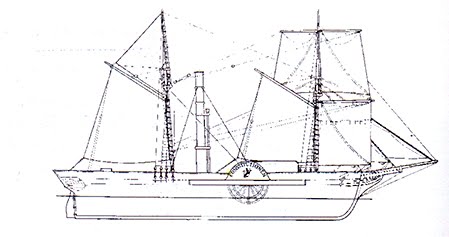
The King and Queen shipyard to the west of where Globe Wharf stands is identifiable today by the bridge that passes over an inlet which is the remainder of the dry dock that once operated here. The upper part of the yard was taken over by William Elias Evans on the death of Peter Mestaer in 1818. The lower part remained unused for some time but Evans took that over too when his business expanded. He built steamers and carried out repairs. Rankin says that he was a poor businessman and in spite of considerable talent and skill experienced financial setbacks which forced him to give up the lower yard and occupy the upper yard exclusively. once again Rankin describes him as a pioneer who suffered impaired hearing which made him withdrawn and diffident. Between 1821 and 1835 he launched the Lightening and the Meteor (both to the right, above). Both were Post Office packet boats based at Holyhead "which proved for the first time that steamships could operate in the open sea all year round" (Rankin 2005, p.93). In 1826 he launched the Constitutionen for the Norwegian post office (picture left) - the first steamer to operate in the Norwegian fjords. He held the upper yard until his death and it continued to operate as two separate yards afterwards. The upper yard was renamed Prince's Dry Dock and the lower one became King and Queen Dock.

Packet boats and ships were carriers of people, freight and post. They were designed to be stable in heavy seas and could cover either large or small distances. The requirement for transportation of freight, post and passengers to the US saw the development of routes from London and Liverpool to New York. The importance of the Liverpool route expanded shipping -related activities on the Mersey, offering challenges to other ship building and repair centres. Many European migrants to the U.S. travelled on these packet ships. The requirement for packet ships was a boost to ship builders who had the skills and facilities to meet that requirement. An 1886 article reproduced in the New York times gives a lovely description of the joys of passenger travel on a packet between Liverpool and New York in 1842;
At the period of which I speak the sailing packets which ran between London and New-York, and between Liverpool and that port, were ships of 500 to 600 tons burden. The staterooms--as the little cabins ranged on either side of the saloon were termed--were below the sea level. They were incommodious, dark and ill ventilated. In fact, the only light they enjoyed was that furnished by small pieces of ground glass inserted in the deck overhead, and from the fanlights in the doors opening to the saloon, and this was so poor that the occupants of the staterooms could not even dress themselves without making use of a lamp. The sole ventilation of them was that afforded by the removal of the saloon skylights, which , of course, could only be done in fine weather. The consequence was that the closeness of the atmosphere was in the staterooms was at all times most unpleasant; while the smell of of the bilge water was so offensive as to create nausea, independent of that arising from the motion of the vessel. In the Winter, on the other hand, the cold was frequently severe. There was, it is true, a stove in the saloon, but the heat from it scarcely made itself appreciably felt in the side cabins. In other matters there was the same absence of provision for the comfort of the passengers. The fresh water required for drinking and cooking purposes was carried in casks; and when the ship had a full cargo, many of these were placed on deck, with the result that their contents were sometimes impregnated with salt water from the waves shipped in heavy weather. At all times the water was most unpalatable, it being muddy and filled with various impurities from the old worm-eaten barrels in which it was kept. Not only was the water bad, but the supply occasionally proved inadequate and when the voyage was an unusually long one the necessity would arise of placing the passengers upon short allowance. There was always a cow on board, but there was no milk to be had than what she supplied, no way of preserving it having then been discovered. Canned fruit and vegetables were equally unknown. There was commonly a fair provision of mutton and pork, live sheep and pigs being carried; but of other fresh meat and of fish the stock was generally exhausted by the time the vessel had been a few days at sea, refrigerators at that period not having been invented.

Over the next few years other railway were built which connected London and Greenwich.

From the 1830s ship breaking began to take over from ship building. Many ships that had been built to fight in the Napoleonic Wars met their end in Rotherhithe. The end of the Napoleonic wars in 1815/16 meant that the skills of shipbuilding and repair were now much less in demand.

It becomes difficult to keep track of the ship yards, their owners and lease holders. Not only were ship yards divided into smaller components or amalgamated into larger enterprises but they were leased out to different owners at different times and owner names changed as new family members joined the business or new partners were included. The uses of these shipyards often changed. Finally, the names of the shipyards were sometimes changed as well.


Amongst the shipyards which were prominent in the first half of the nineteenth century was John Beatson’s ship yard at Bull Head Wharf (which was renamed Surrey Canal Wharf). It was located near the Youth Hostel and Spice Island/Old Salt Quay where 165 Rotherhithe Street now stands (a modern building). Beatsons purchased warships from the Admiralty for breaking up. Examples include the Treekronen (74 guns) broken up in 1825 the Grampus (5o guns) broken up in 1832 and the Salisbury (58 guns), broken up in 1837, the Charybdis (10 guns) broken in 1843 and the Admiral Rainer, an East Indiaman converted to a prison ship and renamed the Justitia, broken in 1855. They also broke up two of the most remarkable ships that saw action in naval battles: the Bellerapheron and the the Temeraire. The HMS Bellerophon had been built in 1786 and was broken up at Beatson's in 1836. A 74-gun ship, she was built at Frindsbury (River Medway) by a builder named Graves. She was engaged at the battles of The Glorious First of June, the Nile and Trafalgar and was one of the best known ships of the Napoleonic wars. She is now perhaps best know for having held Napoleon a prisoner from July 15th to August 7th 1815 before he was handed over to the HMS Northumberland which took him to exile to St Helena. She was converted to a prison ship in 1824 , when she was renamed Captivity, before being broken up in Rotherhithe in 1836.

In 1838 the three-decked 98-gun second rate ship of the line HMS Temeraire was purchased for £5530.00 broken up at their yard on Rotherhithe. Built in Chatham in 1798 she had seen action at the Battle of Trafalgar. Like the Bellerophon she had served as a prison ship, and was then used as a receiving ship before being broken up at Rotherhithe. The ship was so famous and such an enormous vessel to travel that far down the Thames that this last voyage attracted crowds of people who gathered to admire and watch her and the event was reported in the London media. She was the largest ship ever to have travelled that far upstream (the biggest ships trusted for construction to private firms were 74-gun ships). She was the subject of Turner’s famous “The Fighting Temeraire”, and even though it seems that many of the details in this painting were incorrect it is still a fabulous testament to a once great ship. Turner may or may not have seen this event, but he certainly captured all the glory and sadness that surrounded her - the unutterable sense of something so magnificent being dragged to a sorry end. I had a copy of the painting hanging on my bedroom wall from when I was sixteen years old.


There is a sketch of her by William Beatson at her final resting place at the yard, where she looks really very sad (at the National Maritime Museum) Some of her timbers were used to build altar rails, a communion table and two bishop's chairs which were installed in St Paul's Church off Rotherhithe Street (now destroyed). The table and chairs are in are now in St. Mary's Church, Rotherhithe where they were moved after the Second World War.


The foundations of John Beatson's house at the yard were found in excavations at the site in 2000 (Heard and Goodburn 2000, p.26). It was a Regency style house to the south-west of the wet dock with bow windows and steps leading up to a front porch, the facade of the house facing the wet dock which opened out onto the Thames to the east. Two rooms at the front were separated by stairs going to an upper storey and there were another two rooms at the back. The house had apparently been destroyed by 1894 because it does not appear on the map of that year. Adjoining the house was brick built warehouse which extended to the river. It can be seen, in part, on William Beatson's sketch of the Temeraire. It consisted of four levels each with a large door for unloading commodities. The site plan copied above is published in Heard and Goodburn 2000 (p.29) with the foundations of the house and warehouse clearly shown facing the dock.

Beatsons were also involved in ship repairs and timber imports, with a big storage building on the south side of Rotherhithe Street, opposite their Thames facing operation. In 1839 they sold 4062 sleepers to Taff Vale Railway.


In 1838 Bull Head Dock became a general engineering workshop for the Thames Bank Ironworks and in the 1840s the victualling yard was used to expand the gasworks and eventually the entire remaining site was sold to form the Surrey Entrance Lock and the Surrey Basin.


In 1840 the first postage stamp was introduced, part of a series of reforms to the postal system which standardized and simplified the formerly expensive and complex process of handling and delivering post.

A report which appeared in 1843 said that 30,000 of Southwark’s residents had no piped water. If you want to see a hair raising account of health and sanitation issues in the Southwark area at this time see Leonard Reilly’s book Southwark: In Illustrated History (1998, particularly p.56-61). Rotherhithe was one of the poorest areas at this time.


The 1843 map to the left shows the extent of the Rotherhithe docks and ponds at this time. The Grand Surrey Canal basin opened out onto the Thames at the west, and the canal had been widened at its northern end to form the Grand Surrey Inner and Outer Docks (the latter later becoming Russia Dock and now incorporated into the main thoroughfare through the Russia Dock Woodland). Greenland Dock to the south was half its present size with the Surrey Grand Canal passing across its end. The East Country Dock had been built in the early 1800s over 5.6 acres on land now covered by South Dock. The other docks, connected to Greenland Dock which had access out onto the Thames to the east of Rotherhithe are marked simply as the Commercial Docks on the map. They were, heading north, Norway Dock (today a housing development built into the shallow remains of the dock called "The Lakes"), Lady Dock, Acorn Pond and Lavender Pond.

The dockland areas of Rotherhithe were now increasingly focused on timber and grain. Timber ponds were used as part of the timber processing system. The timber, imported from Canada and the Baltic, was floated in the ponds in order to remove sap from the wood. Open sided sheds were constructed in order to store the timber. Grain also required dockside storage and granaries were built to accommodate it.

As well as ship building, maintenance and repairs around the edges of Rotherhithe and commodity handling in the centre of Rotherhithe there were numerous supporting businesses in the area. On the river front along the short section between King's Stairs to Elephant Stairs Humphrey (1997, p.41) says that there were 4 mastmakers, 1 shipmaker and 2 shop's blockmakers. Rope makers worked inland because of the space required for rope production but there are deeds in the Southwark Local Studies Library for one between Rotherhithe New Road and Southwark Park Road. A look at the 1843 map of the area shows rope walks at Bermondsey Wall East (formerly Rotherhithe Wall), to the west of Marigold Street.


Humphrey (1997) says that in 1843 the Commercial Dock Company was paying around one fifth of the parish's rates.


One of the most remarkable feats of the early 1800s in London was the design and construction of the Thames Tunnel. In 1842 the Brunel engine house was built and in 1843 the Thames Tunnel opened. The Brunel engine house, now a museum, provided a steam pump to remove water from the Thames Tunnel. It was restored in the late 1970s with a replica of the cast iron chimney added in the early 1990s. The shaft of the Thames Tunnel still survives and when work on the East London Line is completed in 2010 should be opened, once more, for visitors to view in person.

By the mid 1840s there was a clear dichotomy in the shipping activities in Rotherhithe between businesses operating on the Thames fringes of Rotherhithe and those operating in the expanding dock system within the centre of Rotherhithe. Ship builders were building a mixture of wooden, composite and iron ships but ship construction was being gradually replaced by repairs, maintenance and ship breaking. The docks mainly dealt in the handling of commodities - particularly timber and grain.


References in this post can be found in the site bibliography at:
http://russiadock.blogspot.co.uk/2008/05/rotherhithe-bibliography.html