Saturday, July 6, 2013

From Rotherhithe to Australia: The 1830 steamship William The Fourth


Soho Foundry, where the William the Fourth's
engine was manufactured.
As towns in the early nineteenth century in the area began to expand to fill the areas between London and the coast, a large number of steamboats became the main links between Thames-side towns and the city.  

In 1830 Rotherhithe shipbuilder William Elias Evans (of whom there are more details on an earlier post) was commissioned to build a new steam boat for the Margate Steam Packet company.  Evans specialized in steamships and operated out of the King and Queen yard near the modern Old Salt Quay public house.  Named William The Fourth, the paddle steamer was small, at 34.9m in length, with a 4.9m beam, a depth of 3.2 m and a relatively shallow draught of only 1.1m. She was fitted with a two-cylinder side-lever engine, which was built in Boulton and Watt's Soho (Birmingham) Foundry. James Watt is an important name in steam engine design, having introduced the idea of a separate fuel-saving condenser to Newcomen's widely used engine design. An unusual feature was the geared drives that ran from the crankshaft to the paddle wheel shafts.  She developed 375kw and pulled 70 horsepower.  Sadly I have been unable to find an illustration or photograph of her.

Steamers leaving Margate,
from the Margate Local History website
Two-masted and schooner rigged, William The Fourth served on the Thames until 1837, when she was re-registered in the name of Joseph Hickey Grose (1788-1849). Although born in Deptford, London, Joseph Grose relocated to Australia, where he commissioned a steam ship (also, somewhat confusingly, called William The Fourth but known locally as the Billy), which was launched on the Williams river in 1831, Australia's first coastal steamer.  He then imported two steamers from England - the 141-ton paddle steamer James Watt in 1837 and the Rotherhithe William the Fourth in 1838.  With her shallow draught it must have been an interesting trip, but she made it successfully, arriving in Sydney in January 1838.  To eliminate confusion with the Billy, she was renamed King William The Fourth. Although swift, she was deemed too light for the waters in which she was initially put to work, and was transferred to the east coast of Australia, where she became the first steamship to enter the Clarence River. 

King William The Fourth holds the unfortunate record of having been the first ship to be wrecked in a storm on Oyster Bank at Coal Island at the entrance to Newcastle Harbour (many successive ships fell victim to Oyster Bank, with over 200 ships being wrecked entering and leaving at Newcastle Harbour). She had already lost her funnel at an earlier point during the storm.  Fortunately there were no casualties, thanks to the Harbourmaster, G.W. Jackson, who established a lifeline between the ship and the shore.  The ship was lost, but her boilers and engines were recovered and her engine was placed in The Sovereign, which kept going until 1847 when it too was wrecked.


Friday, July 5, 2013

A new sculptural feature for Brunswick Quay?


Flicking through the planning applications in Southwark News today I came across this rather interesting planning proposal for Brunswick Quay (overlooking Greenland Dock).  REF 13/AP/1944 describes the proposed installation of a "portrait bench" with three life-sized figures made of caten steel arranged around a timber bench and set within an existing paved area, near to a Grade II listed capstan.  I've looked at the Southwark Council planning pages and there is no indication of who the sculptor is and there are no artist impressions of what it might look like, although presumably it will be something to do with local history (although that may be an assumption too far).

Laura Ford's "Nature Girls,"
stolen in 2008
I am all for new features that make the area look cared for and happily lived in, and although I haven't found an impression of what it will look like if built, the portrait bench seems like a nice idea, particularly if its theme is relevant to the area.

My only concern, and I really hate to chuck cold water all over something positive before I've even seen a picture, is that it may eventually be targeted by thieves.  The "Nature Girls" sculpture by Laura Ford at Surrey Basin (or Surrey Water) was stolen in 2008, sawed off at the ankles leaving just the red shoes, as was the much-loved sculpture of Alfred Salter near the Angel pub (stolen in 2011, photo here on the SE1.com website) and the owl from the set of farmyard animals and fox on the Thames Path (the survivors of which had to be removed to within the Surrey Docks Farm premises to keep them safe).  It is thought that they were probably stolen for their scrap value, which is so sad.  Having said that, the Michael Rizzello sculptures of James Walker, overlooking Greenland Dock, and the dock layout in the 1800s at the top of Stave Hill, as well as the pilgrim sculpture near The Mayflower, have all survived.

It's a rather gloomy dilemma. Either one fails to keep introducing innovative features into the area in fear that they might be ruined; or one takes the risk.  On balance, I'm very much in favour of staying optimistic.  I can't figure out exactly where it will be located, but hopefully it will be in sight of local homes so that residents can keep an eye on it.  At the moment no-one has contested the planning proposal so hopefully it will go ahead.

I've emailed the Southwark planning officer to whom the proposal is assigned, Terence McLellan, and hopefully he may be able to rustle up an image of how it will look.


Thursday, July 4, 2013

Bermondsey Carnival this weekend in Southwark Park


I've just noticed that Bermondsey Carnival is being held this weekend in Southwark Park, with activities focused on the bandstand area. Admission is free and there is live music from 12 noon to 8pm.  
Details can be found on the Southwark Council website at:
http://www.southwark.gov.uk/info/200157/festivals_and_events/2648/bermondsey_carnival/1

Southwark Council £23million gap in next year's budget

Oh joy.

I'm a bit late getting to it, but the June 27th Southwark News (Oliver Pugh) has reported that Southwark Council has identified a £23million hole in its budget (difficult to miss a hole that big) and may start reducing or eliminating services.  Government cuts are being blamed.  Naturally, there is now mud-slinging and the apportioning of blame between the different political parties involved in Southwark. 

Councillor Livingstone is reported saying that tough decisions are going to be made, but that the local community will be consulted. Quite how this will fit in with the new fast-track planning regulations recently announced by the government, which effectively cut residents out of the loop of some planning decisions, will be interesting, and possibly very grizzly, to observe.  As Southwark are pleading poverty over the seriously low-cost task of replacing nesting pontoons on Greenland Dock whilst accepting the income from really unsympathetic planning proposals like Ontario Point, I really wouldn't be surprised if there is another attempt to establish an extended marina on Greenland Dock to turn the much-valued open water into a revenue generating proposition.

It will be worth keeping an eye open on their future plans for development in Rotherhithe and elsewhere in Southwark. We'll just have to wait and see.


Built in Rotherhithe: The first Post Office steam packets


The remains of the King and Queen dry
dock, where Lightening and Meteor
were constructed
The first two Post Office steam packets were built in Rotherhithe by William Elias Evans at the King and Queen dry dock, not far downstream from the modern Old Salt Quay public house, the dock's remains partially preserved as an inlet with a modern bridge crossing it.

Named Lightning and Meteor, the two paddle steamers were commissioned by the government-operated Post Office from Evans to serve on the run between Holyhead (Anglesey, north Wales) and Howth (a coastal suburb of Dublin in southern Ireland).

Having served an apprenticeship as a shipwright in a private yard, William Elias Evans was a pioneer in steamship building.  He is an under-sung hero of early steamship design, which Stuart Rankin suggests may have been because although he was an innovative and successful ship builder, he was a poor business man, was declared bankrupt more than once, was frequently in arrears with payments, refused to participate in the lockout that lead to the shipwright's strike of 1825 and, being very hard of hearing, was also somewhat socially inept. In an era when sailing ships were in decline, however, he built many steamships between 1821 and 1835, including  the pioneering Constitutionen (the first steamship in the Norwegian fjords), William the Fourth (which was taken to Australia and put into service in coastal and riverine waters), the London and Gravesend Packet Sons of Commerce, the Margate Packet Victory and Thames steamers London, Favourite and Diana, of which more in future posts.  It is likely that as well as building directly for his own customers, he was also contracted to build ships by other shipbuilders. Lightning and Meteor are particularly important because as well as being the first Post Office packet steamers, they were amongst the first steamships to prove that paddle steamers, unassisted by sail, were seaworthy, fast and reliable all year round. 

The first Post Office packet boats at Holyhead were introduced in the 16th Century, to establish a postal link between Britain and Ireland.  This was later supplemented by other services that crossed the Irish Sea between other ports.  Boats ran to Post Office schedules, but were operated on a contract basis, with sailing ships paid to provide a licensed mail service, making their profit on cargo and passenger transport.  In the early nineteenth century this changed.  For the first time steam had proved to be successful on sea ships. Between Wales and Ireland private companies had set up in competition with the Post Office sailing ships, dependent not upon the vagaries of the wind but upon steam engines that could travel in the calmest seas.  The competition, carrying Post Office mail from the mainland to Ireland, was both  both illegal and threatened the profits of sailing ship operators.  The government decided that in the face of swifter services that were preferred by travellers, the Post Office would also enter the steam era.  They commissioned two steamers, Lightning and Meteor, from steamship specialist William Elias Evans in Rotherhithe. Both paddle steamers were built under Admiralty supervision.  

The construction of Lightning and Meteor was overseen by the Master Shipwright at Deptford, Oliver Lang, Both had two engines. They went into service in 1821, carrying Post Office mail, cargo and passengers to Ireland.  the average passage of Meteor from Howth to Holyhead was 8 hours and 13 minutes.  Unlike sailing ships, which could not operate during during calm weather when there was no wind to catch their sales, the paddle steamers were limited by stormy weather, which restricted their ability to run. 

The steam packet boat Lightening, just off centre,
with Meteor to the far left of the painting and the Royal George
just to the left of Lightening, flying the Royal Standard.
By William John Huggins 1822.
National Maritime Museum
Lightning is particularly well known both due to her royal connection with George IV and because of the rather lovely painting that was produced as a result.  In 1821, the same year in which the two steamers were put into Post Office service as packet boats, King George IV sailed on his ship Royal George, destined for a state visit to Ireland. Different versions of the story say that his ship was either becalmed or met with winds that prevented his timely arrival at his destination. He reached Holyhead but could travel no further on his own ship. Whatever the cause, the decision was taken for him to leave the Royal George and transfer to Lightning instead, accompanied by Sir Francis Feeling (Secretary of the Post Office) so that he could keep to his agenda. Lightning, commanded by John Skinner, departed Holyhead on the 7th August 1821, arriving in Dublin the next day. On board, it is reported that he passed time by eating goose pie and drinking whiskey.  As no-one realized that the King was on board, his greeting was somewhat informal, but a great success.  Lightning was afterwards renamed Royal Sovereign King George the Fourth, usually shortened to Royal Sovereign or Sovereign.

The captain of Lightning, John Skinner, was a Royal Navy veteran and was put in command of several sailing packets before being put in command of Lightning.  A monument to him, in the form of an obelisk, still stands in Holyhead harbour.  Lightning, by then Sovereign, was eventually transferred to the Admiralty and renamed HMS Monkey.

It became clear that the steam ship services introduced onto various postal routes were unprofitable. They were expensive to build and the Post Office had neither the expertise nor the experience to run them efficiently, resulting in substantial losses.  As a result of these failures, in 1837 an Act of Parliament handed packet operations into the hand of the Admiralty, although the schedules were still determined by the Post Office.

Control of packet services was once again handed over to the Post Office in 1860, but at the end of the 1800s the Post Office began to contract its operations out to private companies again, this time to steam, rather than sail companies.


Wednesday, July 3, 2013

Planning proposal: Convoys Wharf

Thanks to the SE16.com website for pointing out the planning proposals for Convoys Wharf.  As the SE16.com post observes, even though this development will be in Deptford, if 3500 new homes are built it will certainly have an impact on the local infrastructure.

Details of the Convoys Wharf planning application (reference DC/13/83358) are on the Lewisham Council website.  At the bottom of the page you can look at the 56 documents currently associated with the application.

To see what all the Classes mean (A1, A2, sui generis, etc) see the Planning Portal website at
http://www.planningportal.gov.uk/permission/commonprojects/changeofuse/

The Convoys Wharf website is at: http://www.convoyswharf.com/ with an artist's impression of what the development, with significant high-rises, will look like.


A short history of All Saints Church 1839, Rotherhithe


All Saints Church, from
The British Critic Quarterly Theological
Review and Ecclesiastical Record

(Volume 28, 1840, p.496)


All Saints Church, Church Hall,
Graveyard and Vicarage on the
Rotherhithe 1914 (London Sheet
78) Ordnance survey Map
All Saints Church, its vicarage and its churchyard were established on Lower Road in July 1839 and destroyed by a German flying bomb less than a century later on Sunday 13th August 1944.  The site of the church buildings and graveyard today is King George's Fields, on the corner of Lower Road and Surrey Quays Road, a small public park established to commemorate George V, opposite the Dock Offices.  This is a short summary of the church, as I was unable to find out much information.

As with Trinity Church, which was built two years earlier, All Saints was designed by Sampson Kempthorne, who was an innovative designer of workhouses. The lofty The British Critic Quarterly Theological Review and Ecclesiastical Record (Volume 28, 1840) considered both to have have been built with such a restricted budget that they were scarcely worth description, as has already been quoted on the Trinity Church post, but contains the useful information that both were designed to hold 1000 persons, cost about 3400/. and were arranged  for one-third pews, one-third sittings at a low rate for the middling classes, and one-third free seats (p.496).  The British Critic Quarterly approves of the side elevation, with its four windows and its simple steeple and spire, but disapproves of the front, which it describes as excessively crowded "with buttresses and windows of all sorts and sizes, circular and pointed."

A History of the County of Surrey, Volume 4, adds that it had a chancel, vestry, nave (roofed in one span) with a gallery at the west end and that it was built of white brick with stone dressings.

Together, Trinity, All Saints and Chirst Church cost £13,525 to build and consecrate, a sum that Beck generated with the local contributions, the donation of land and the input of Sir William Gomm, Lord of the manor of Rotherhithe. In 1848 Edward Blick recorded that All Saints was endowed with £150 a year. 

As with Trinity, All Saints was built on a fairly tight budget, but it is impressive that in an area where financial resources were at a premium, so many churches were made available for the rapidly expanding communities.  With its simple but elegant spire, and its Gothic Revival touches, this was an admirable contribution to the area.  From the illustration above in the The British Critic Quarterly it looks really rather appealing.

Writing in 1907, Reverend Beck provides a list of the clergy of All Saints, with some interesting evaluations.  Reverend Robert Jones B.A. of Jesus College, Oxford was "an acceptable preacher" and renowned Welsh scholar who oversaw the construction of the vicarage.  He was succeeded by Reverend Christopher Tweddle M.A. of Clare College, Cambridge, on the death of Reverend Jones.  Beck says that his "influence was very great, especially among young men."  Although Beck does not elaborate, a very welcome email from Lisa Ellis provided the information that he died in 1885 at the at the age of 45, a premature death that followed several months of illness.  Lisa cites the obituary in The Church Times, which regretted that "he has been called away in the midst of an active work, which his friends hoped would be crowned with excellent results, and which, as far as it had gone, had already accomplished much.”  It goes on to say that "Mr Tweddle set about in a quiet, earnest, and common-sense way to work up his parish, and all who know what has been accomplished there during his too short incumbency of only five years, will be forward to bear witness to the steady progress and improvement that was taking place, not only in the services of the church, but in the organisation of the parish."   He was followed by Reverend Dr William Delancy West who was a native of Rotherhithe, his father a local ship builder.  He married the daughter of a Bermondsey leather manufacturer.  Beck approved of him, saying "his eloquent sermons and spiritual instructions were very highly valued by all who had the privilege of profiting by them" but he retired after only a year due to the ill health of his wife.  The final incumbent mentioned by Beck was the Reverend John Jervis, M.A., of Queen's College, Cambridge, under whom the parish room was built for Sunday Schools and other activities.

After the church was destroyed, the parish records of All Saints were deposited in the Greater London Record Office, The County Hall, London SE1 7PB, by the Rector of St Mary with All Saints, Rotherhithe, 7 July 1980 (Acc. 1564) (see the National Archive website).

Although All Saints parish was created in 1842, it was amalgamated with St Mary's parish in 1952 to become the Ecclesiastical Parish of St Mary with All Saints, which is now served by St Mary's Church, St Marychurch Street. 

Monday, July 1, 2013

Prince's Tower, Rotherhithe Street


A friend visited over the weekend.  An Egyptologist, he wanted to revisit the so-called Cleopatra's Needle (an ancient Egyptian obelisk on Embankment, on the Westminster side of Blackfriars bridge, that predates Cleopatra by several centuries) to check how much the inscriptions have deteriorated recently.  We walked there  from the end of Greenland Dock along the Thames Path.  I haven't done that walk since last year, and it was great to see some of the familiar sights again.  I took a lot of photographs to form the basis of some future posts.

We passed one of my favourite modern buildings in Rotherhithe, just on the outskirts of Rotherhithe village, behind The Ship pub: the Thames-facing Princes Tower (which at some point seems to have been re-named Riverside Apartments).  Its address is 97 Rotherhithe Street, SE16 4NF and it sits on the site of the old Prince's Wharf and Prince's Stairs. at the start of Elephant Lane.

The award-winning eight storey building has a distinct air of Bauhaus and Modernism about it, with a large dose of Art Deco thrown in; the echo of a brave new world of architectural ideas.  Neatly juxtaposed against the nearby 1930s The Ship, which represents a very different architectural tradition, and the solidly functional nineteenth century buildings of the old wharves, it stands out like a beacon of innovation. It was designed by Troughton McAslan (now no longer operating) and built by Tim Brennan Architects, opening in 1990.  In spite of being unique in Rotherhithe, with nothing even remotely equivalent to compare with it, it doesn't clash with its surroundings.  Built on a steel frame, the design emphasizes curves and linearity, light and and space.  The apartments are light-filled with open plan arrangements, and the views over the Thames through the bow windows are almost panoramic.

In the 1850s Prince's Wharf was the timber-built base of a barge and boat builder, but by 1873 the entire Thames frontage at this point was made up of a series of wharves of varying sizes.  By 1937 Prince's Wharf was a six-storey brick-built wharf next to Gordon's Wharf and linked to it by walkways.  Both had been operated as granaries by Gillman and Spencer, which specialized in landing and bagging loose cereals and the manufacture of flaked maize and brewers' preservatives, but when the company was purchased by Pauls Malt Ltd in 1902 they also manufactured a product called Kositos, an animal feed.

Update: Quite coincidentally, I was trawling through the planning proposals in Southwark News today (3rd July, only 2 days after my original post) and I noticed that there was a planning application (ref 13/AP/1454) to add additional accommodation to Flat 6 Princes Tower.  Without knowing where the flat is in the general scheme of things, it's difficult to form an opinion, but it does seem a shame that the building isn't Grade 2 listed, so that this sort of application has to go through more rigourous checks.


Thursday, June 27, 2013

A late Nineteenth Century pub - The Ship and Whale

It is often very difficult to work out where various buildings and roads on old maps were in relation to the modern layout, because so much has changed in the last 150 years.   Not only road layouts change, but road names are altered too.  Both the wartime bombings and the 1980s development of the area have wrought many changes on the landscape, which are very visible when comparing maps from different periods.

On the 1868 Ordnance Survey map (sheet 68) there were no references to Elgar or Odessa Streets, which were then Thames and Lower York Streets, with a Russell Street running between them and parallel to them. The change of road names took place sometime before the 1914 map was issued.  On the 1868  map, copied on the left, the location of the Ship and Whale is picked out in red.

A Ship and Whale public house is first recorded in 1767 and was named for the whaling industry that was the main purpose of Greenland Dock at this time.  However, the current building is not the eighteenth century original. It is not known what happened to the previous building and why it had to be replaced.

A public house is marked on the 1868 map as P.H. on Russell Street (and is now on Gulliver Street). The style is certainly consistent with a late nineteenth century date. The first floor has evenly spaced sash windows, typical for the day, with white blocking at the brick-built corners.  With a door at each end of the building's ground floor facade, the decorative window area is uninterrupted, and provides an attractive symmetry to its overall appearance.  It's a really fine piece of late nineteenth century vernacular architecture, completely consistent with other Rotherhithe buildings of the era, and it's a shame that so little is known about its past. 

It is one of a small number of buildings in the immediate area to survive the Second World War bombings in what was once a discrete residential and wharf area on the edge of Greenland Dock, of which there are very few remains. Odessa Wharf is another very fine building, sitting directly behind the Ship and Whale, dating to 1810, and now converted to apartments.  Randall's Rents, a small alley leading from behind the Ship and Whale, runs up along the side of Odessa Wharf and connects with the Thames Path. These survivors are surrounded by a series of very distinctive post-war developments, some more admirable than others.

The ship-building and grain storage focus of the area is clearly visible on the above map, where a saw mill is shown at the top of the page, the Commercial Dry Dock is shown at bottom right and a vast granary fronts onto the Thames (where New Caledonia Wharf is now located). There were also three more pubs in the immediate area: one at the other end of Russell Street (where the much later Orange Bull is now located), one on Thames Street and one on Lower York Street (the latter apparently where the Ship York is located). The Downtown area, a short walk to the north, supplied a church and a school (which survives as Trinity Halls), and at least one more public house.   The commercial focus of the area was shifting radically at this time.  The ship building industry in Rotherhithe was now in decline after 300 years, and the network of docks had expanded from the early 1800s to take up most of inland Rotherhithe.  The future was already on its way when the Ship and Whale was built: cargo handling and storage, mainly timber (in particular deal planks) and grain.


Today the Ship and Whale is owned by the Shepherd Neame brewery, and the bar area has been furnished very sympathetically with a variety of old mixed wooden tables and chairs and sofas.  There is an extended patio area at the rear of the building.  The upper floors are currently used for staff accommodation.  If you're planning to visit and look at the interior as well, you should note that it is closed during the day Monday to Friday (at the time of writing).  

Ship and Whale website:


Wednesday, June 26, 2013

The Beatsons - the Rotherhithe ship-breakers who broke up the Temeraire

The Bulls Head Dock, where the Beatsons were
based, from the 1843 map of the area. It is
immediately to the north-east of the Old Salt Quay.
Ship breaking was an essential part of the life-cycle of a ship.  Warships that survived their wartime careers were sometimes sunk to form reefs, but many were sold by the Admiralty to private companies for breaking up when their useful life was considered to be over. This was a mutually beneficial partnership, in which the navy was able to dispose of its unwanted ships for a fairly substantial sum of money, and private enterprises could break the ships and sell off the component parts for a profit. To provide some idea of the sums of money involved, in the 1830s John Beatson paid £5530 for HMS Temeraire and researcher Stuart Rankin found records of a transaction in which  the Beatson yard paid £4350 for an East Indiaman called the Warren Hastings. Although currency conversions between past and present are notoriously difficult and controversial, there is a currency converter on The National Archives site that supplies a modern (2005) value of £243,873.00 for the £5530 paid for Temeraire and £191,835.00 value for the sum paid for the Warren Hastings.

Breaking a ship was labour-intensive work, and often difficult. Long lengths of wood were particularly valuable, and the main source of profit, but all wooden and metal fittings were removed and sold off, including old rope  (called junk) that had deteriorated to the point where it was no longer usable, and was sold for the making of fenders or the fabrication of oakum from the dismembered threads (which was tarred and used to plug gaps in ship decks, and was often made in work-houses and prisons).  Selling ships to specialized breakers is a solution to unwanted warships that is maintained by governments today. 

Although ship-breaking was almost certainly carried out throughout the three centuries of the Rotherhithe ship building industry, it became particularly prevalent during the 19th century when ship-building along the Thames went into decline.  Although some ship builders were able to produce new types of ship using new techniques and technologies, others went out of business or turned their focus increasingly to repairs and ship breaking.


HMS Temeraire beached in front of Surrey Canal Wharf
in 1838 by John Beatson's younter brother William 
(National Maritime Museum. Greenwich)
The most famous ship to be broken up in Rotherhithe was the 98-gun first rate ship of the line HMS Temeraire, which was broken up at the Beatson Surrey Canal Wharf site in 1838. The ship was immortalized in J.M.W. Turner's fabulous oil painting "The Fighting Temeraire." She had performed an important role at the Battle of Trafalgar under the command of Captain Sir Eliab Harvey, and was justifiably well known in her own time. The painting is not an accurate depiction of the ship, or even the event (she was guided along the Thames by two tugs, Sampson and London, not just the one shown in the painting) but is very beautiful. Turner had seen Temeraire quite by chance from one of the steamships that carried passengers between London and Margate. She may have been fitted with temporary masts for the 35 mile journey from Sheerness to Rotherhithe, leaving Sheerness on the 5th September and arriving in Rotherhithe, in bright sunshine, on the 6th September 1838, but the masts, if fitted, were removed on her arrival. Apparently Beatson had a tradition of holding a party on board ships to be broken, and this was maintained with a party held on Temeraire as she travelled upriver.  All of the ship's copper sheeting and bolts were returned to the government. A first rate ship of the line, she was the largest ship every sold off by the Admiralty at this time.   Wood from the ship was used to make various architectural features and furnishings for St Mary's Rotherhithe and her chapel of ease St Paul's, including columns, chairs, a table and altar rails. According to an article published in The Times on 12th October 1838, one piece of wood rather endearingly went to a former sailor on the ship, to provide him with a false leg to replace the leg he lost at Trafalgar. There are more fascinating details about the final journey of Temeraire in an article in Country Life magazine by Martin Postle, published in September 1988, partly informed by Beatson's great great grand-daughter. 

The Bellerophon, also broken up at the Beatson yard, was another well known ship, famous for receiving Napoleon's surrender and transporting him to St Helena, where he was exiled.  

A chair made from the timbers of the
Temeraire, one of two that are now
in New Zealand. This one is a family
heirloom owned by one of William
Beatson's descendents. Used
here with my thanks.
Stuart Rankin's extensive research into Rotherhithe's maritime past has shed a lot of light on the Beatson family and their activities. Fortunately, one of the few archaeological excavations to be carried out in Rotherhithe took place at Pacific Wharf (165 Rotherhithe Street, a modern 72-apartment building) over two months in June 2000, and the findings from the excavation were published by the Museum of London's Archaeology Service in 2003: Investigating the maritime history of Rotherhithe, by Kieron Heard with Damian Goodburn. This has provided a lot of information about the structures present at the site from Medieval times onwards. 

Previously occupied by three other families involved in the shipping industry (The Warrens, Shorters and Woolcombes), Bulls Head yard (now known as Pacific Wharf) was taken over by the ship breaking partnership of William Beatson, John Beatson and Brodie Augustus McGhie after the departure of the Woolcombes at around 1810.  According to E.J. Beck's Memorials to Serve for a History of the Parish of Rotherhithe (1907) John Beatson was of Scottish descent,  son of David Beatson who came to London in about 1790 when he was 19-20 years of age, to join cousins who were breaking ships at Surrey Canal Wharf.  Beck says that he inherited the business, which he passed to his son John, but there seems to be some confusion.  Stuart Rankin's research indicates that by 1815 William Beatson was no longer an active participant, that the Bull Head Dock was occupied by Young, hawks and McGhie by 1820 and that David Beatson concentrated on ship breaking at the Surrey Canal Wharf (the western part of the Bulls Head Yard site, previously known as Bulls Head Wharf).   Eventually the business passed to David's son John Beatson.  John, who was also was Churchwarden of the parish, ran the business until he died in 1858, after which Surrey Canal Wharf was taken over by another ship breaker, William Phillip Beech.

Principally ship breakers, they also engaged in repairs and were timber importers.  Stuart Rankin records that they supplied 4062 sleepers to the Taff Vale Railway in 1829.

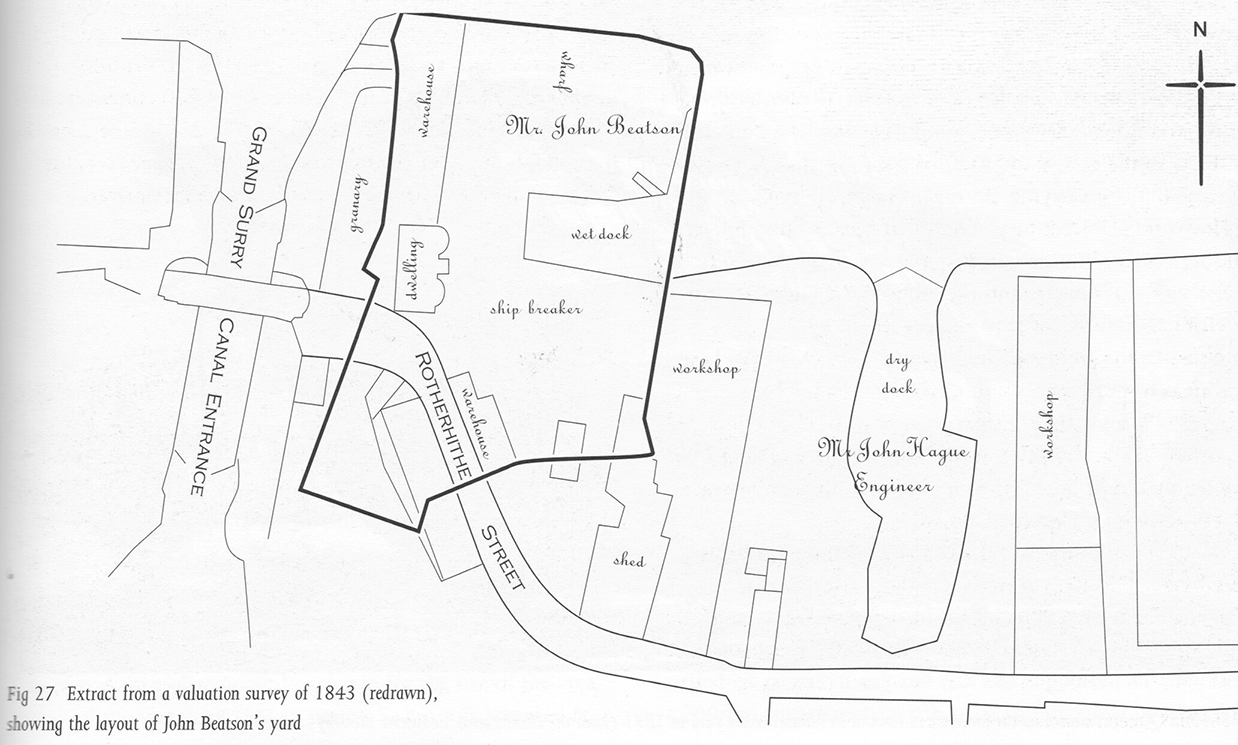
Extract from a valuation survey of 1843, showing the
layout of the John Beatson yard, copied from
Museum of London archaeological report
(Heard and Goodburn 2003)
The research conducted by the Museum of London revealed a valuation survey of 1843 that recorded the layout of the John Beatson yard at that time, showing wet dock, riverside wharf, brick- and timber-built warehouses, a shed and timber storage (illustration from the Museum of London report, p.25).  It also shows the location of a Regency style house, the brick foundations of which were located during the excavations. With two rooms at the front separated by a hallway and stairs and two rooms at the back it had a pair of bay windows, overlooking their yard, and steps leading up to a front porch.  At some point one of the wooden warehouses was demolished and replaced by a crane.  There are records of a crane being purchased from a Mr Lloyd in 1832 for £115.  Areas of open yard between the various structures produced "a sequence of metalled surfaces interleaved with layers of silt, containing timber debris, fragments of ships' caulking (waterproofing material inserted between ship timbers), treenails (wooden pegs) and iron spikes" (p.27).

A selection of the names of warships that are thought to have been purchased from the Admiralty for breaking are as follows (but please note that different references have different lists):
  • Rotterdam (50 guns) 1806
  • Texel (64) 1818
  • Tagus (38) 1822
  • Treekronen (74) 1825
  • Grampus (50) 1832
  • Salisbury (58) 1837
  • Temeraire (98) 1838
  • Charybdis (10) 1843

HMS Bellerophon anchored in Plymouth Sound,
with Napoleon Bonaparte aboard. Detail of a
painting by John James Chalon
My thanks to Jaqueline Day for letting me know that Treekronen was a warship captured from the Danish.  They also purchased two prison ships.  The 74-gun HMS Bellerophon had been renamed Captivity when she was converted for use as a prison ship and was purchased by Beatson in 1836.  The other had been an East Indiaman called the Admiral Rainier, whose name was changed to Justitia for her role as a prison ship, and she was purchased in 1855.  The Beatson yard may also have broken up several of the East India Company's merchant vessels.  Beck says that they also broke up "most of the old East India Company's ships, among others the Sesostris and the Thames" (p.170).  Other warships may have been purchased through intermediaries.

St Paul's Chapel, Rotherhithe,
designed by William Beatson
Stuart Rankin has studied the complex daybooks and ledger that record the accounts of the Beatson business between 1825 and 1858, and anyone interested in his analysis should certainly read his account in the booklet Shipbuilding in Rotherhithe - Bull Head Dock to the Pageants - Part 1 (Rotherhithe Local History Paper No.4a, 2000). Rankin says that the Beatsons were dealing with most of the Thames yards, and that many of the transactions between the Beatsons and regular customers were carried out on a semi-barter basis, with goods as well as cash being exchanged for services and products.  He also found a couple of cases of minor tax fiddles.

John Beatson died in 1858. Although there is a record of John having married and having had a son (also John, about whom nothing else is known), he left instructions in his will for the business to be sold.  John's  younger brother William was educated at Eton and trained as an architect, and was responsible for St Paul's Chapel in Rotherhithe. He emigrated to New Zealand, where some of the items associated with the Beatsons are now preserved. 


Many thanks to Ken Beatson for the photograph of the lovely chair, and for the Country Life article.


Monday, June 24, 2013

News update about the 1902 Yard Office

On Saturday I emailed Nicky Costin (Southwark Council's Road Network, Parking, Street Markets and Marina Business Manager) regarding the deteriorating appearance of the 1902 Yard Office on the corner of Sweden Gate and Rope Street.  I expressed the concern that once a building begins to deteriorate in appearance due to damage and neglect it ceases to be valued by the neighbouring community and can quickly become the target of vandalism.  Mr Costin replied to me on Sunday to say that he would investigate, and this evening he has emailed with the following promising udpate, with my thanks.  I will keep readers posted.

The harbour master has looked at it. It is a brick build structure 5.1 by 3.6 metres and was probably a pump house originally.
Currently it is a substation according to the big yellow sign on the door (and the ones warning of danger of death on all sides). Ref no 93657. He has spoken to UK power networks who also agree it's a substation but they were not sure if it is disused or not. Regardless they were going to contact their estates department to send someone out to survey it and do any maintenance required. As soon as they come back to the harbour master he will contact you.

Stuart Rankin, who has researched the local history of the area, thinks that it was an office for collecting tolls from vessels passing through the Grand Surrey Canal,  but whatever its purpose it is a splendid little building and it needs to be preserved.